Students typically start exploring positive and negative numbers towards the end of elementary or early middle/junior high school. And it can be a bit weird. It is literally the opposite of what they had been taught for the last ten years in a number of ways (Puns intended.). Here are some ways you can support your child in their negative number journey to make it a positive experience (Dang, I am on FIRE!).
- Bring in finances. “In the Red” and “Black Friday” are references to business. When a company in “in the red”, they are in debt. They owe money. Traditionally “Black Friday” (The Friday after Thanksgiving) was the first day of the fiscal year companies got out of the red and posted a growth. Credit cards are another great place to explore debt and credit. A debt would be what you owe and would be represented as a negative number. A credit would be a positive number. Show them your mortgage and credit card statements and discuss terms such as “deposit, credit, debt, with drawl, etc.”. The stock market is a great place to discuss negative and positive fractions and decimals. Pull up the daily NYSE and discuss which companies have an increase (or positive) and which have a decrease (or negative) change that day.
- Football Season!!! This is a fantastic place to bring in integers (positive whole numbers and their opposites). If I gain six yards on a drive, how could I represent that change? (+6 or 6). What if the QB gets sacked? How many yards did they lose? (ex: -7). How far do they now have to go to get a TD? If your child is interested in football, use it to your advantage!
- Playing Cards. Below are a couple of games you can adapt to include negative numbers. I prefer to omit the face cards and only use numbered cards, but you can make Aces = 1 (and -1) and the face cards values after 10 (and -10).
War! Black Cards are positive values; Red Cards are negative values
- Shuffle and divide the cards evenly among players. Keep your cards in a pile face down. Everyone flips over their first card. Player with the greatest value wins all the cards for that round. Tie? Flip another card and whoever has the greatest value that round wins all the cards from both rounds. Whoever has all of the cards at the end (or the most cards when you get bored) is the winner.
Example: I flip over a red 9 (-9) and you flip over a black 2 (2 or +2). A gain of 2 is greater than a loss of 9 so you win the cards.
You can also play that the winner is the one with the smallest value.
- For students who are learning to add integers. Shuffle and divide the cards evenly among players. Keep your cards in a pile face down.
Everyone flips over TWO cards and finds the sum (add them). Whoever has the greatest (or least) sum wins the cards for that round.
Example: I have a black 2 and a red 4. 2 + (-4) = -2.
You have a red 4 and a red 2. -4 + (-2)=-6.
Since -2 is greater than -6 (a loss of 2 is better than a loss of 6), I would win.
- Go Fish! Black Cards are positive values; Red Cards are negative values
Shuffle and hand each player 7 cards. The rest are in a pile in the middle face down. The objective is to be the first one out of cards.
How do you get rid of cards? By making matches of cards that have a value of 0.
Example: Jen has a 5 black (5 or +5). She says to Chris, “Do you have a negative 5 (5 red)?” Chris does, and hands the 5 red (or -5) to Jen. Jen takes the positive 5 and the negative 5 and lays the pair in front of her.
This is not an exhaustive list so I will be adding other fun ways to integrate math into your home conversations. Let’s make math a positive experience for our kiddos!
 What is the same about each? If I am thinking about this as a partitive model and using base 10 blocks, I am sorting the amount I am given into 3 equal groups each time.
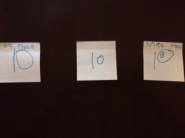 (Note: You can also include the symbols <, =, >, but I prefer to work on the concept FIRST then introduce the symbolic notation later.) Place the post-its on a workspace that has lots of room.
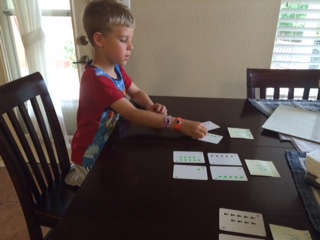 k and place two cards face-up for the child, but if students are playing in small groups they take turns taking the top two cards and placing them face-up. The child decides whether the sum is less than 10, the same as 10, or more than 10. If in small group, the others confirm or debate. Once the value is established, the student puts the cars face up as a pair under the correct post-it.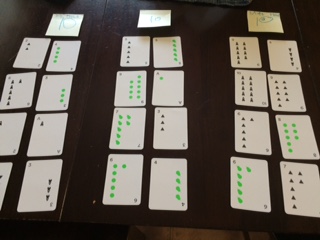
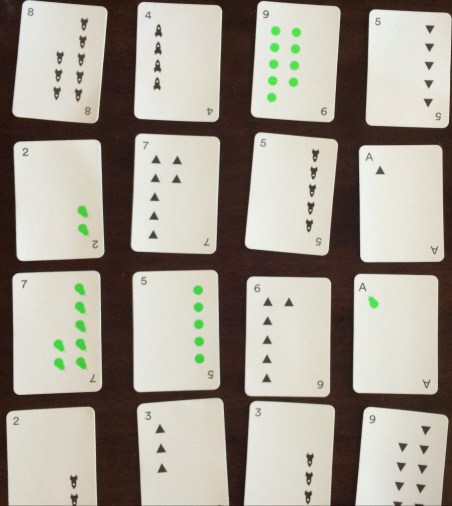
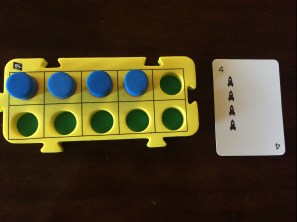
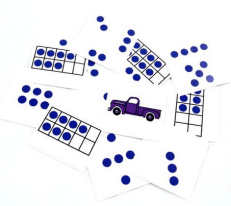 They also have fantastic dot cards/ten frame cards together for some great exploration!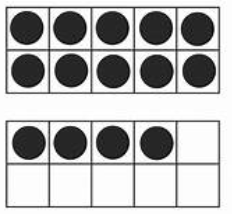

 r we used with those groups: 3, 5, 5 (upside down), 8, 10, 12, 15, 14, 20, 18. 18 was tough (see the number of dots), as students really needed to push to 5’s versus counting 10 then by ones.

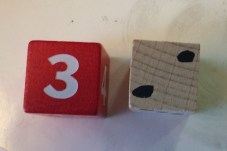
 Player 2: Roll dice, count on, and place the object on her game board. Continue until someone reaches the top of a column.
 moffett4understandingmath