Game: Making Ten

Kindergarten kiddos are immersed in addition and subtraction right now! They are exploring addition as adding more ‘stuff’ and subtraction as taking away (or removing) ‘stuff’. Many of the kids are in their Level 1 Counting All stage in which they rely on counting one-by-one to get the sum or difference.

For example: 3 + 4. A child at this level would count 1, 2, 3 then 1, 2, 3, 4; putting them together, 1, 2, 3, 4, 5, 6, 7.

This is acceptable for Kinder kiddos! This is awesome! This is the first step! But it isn’t where we want them to stay, particularly at the end of first grade. I tutor some students in grade 1 who haven’t moved past this level. So I took a game that has been around and edited to push kids into Level 2 Counting On.

Make a Ten!

Object: To find as many pairs of cards that add to 10 in your round.

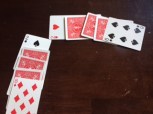
Materials: Cards 0-10 (4 of each). Note: This is the most crucial component. I will talk more about the cards below.

Directions: (Below is a video clip. Sorry about the sniffling; it is allergy season here in TX!)IMG_9347
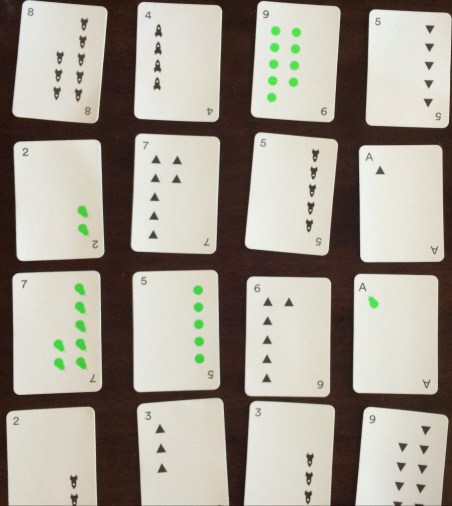
  1. Shuffle the cards. Lay out 4 rows of 4, face up.
  2.  Player 1 finds as many pairs of cards that add up to 10. He takes the cards and (I made them do this!) says, “________ and __________ make 10!” He continues until there are no more cards that pair up to make ten.
  3. Take the remaining cards (if any) and put them back in the pile. Reshuffle and lay out 4 more rows of 4 cards.
  4. Player 2 finds as many pairs of cards that add up to 10. She takes the cards and (I made them do this!) says, “________ and __________ make 10!” She continues until there are no more cards that pair up to make ten.

Continue alternating until there are not enough cards left to play. Player with the most cards wins.

Adaptations

Chris did struggle with 4 + 6 (or 6 + 4). I pulled out a ten frame to help with, “How many more do you need to make 10?”. img_9356.jpg
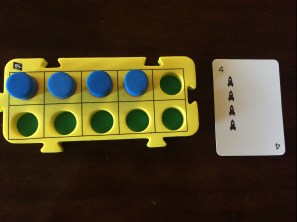
Chris refused to have any extra cards. In fact he got quite cheeky about it. This was his modification (he called it a ‘cheat’). I was perfectly fine with it, as I am sure you would be as well! I did not give him the word ‘altogether’ to use; that was a natural piece of the conversation. Woot! Woot!


Card Choices

  • If you are just starting out, only use 0-5 and make sets of 5. This is foundational and kids do not spend enough time on fact fluency to 5 before jumping in to 10.
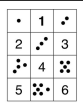
  • The cards I used were from Eureka Math. I love them, as they are friendly shapes and are in sets of 5’s. So 10 is represented as two-fives. This link will get you to the cards I used as well as others they have (like ten-frames) http://eurekamath.didax.com/exclusive-items.html/
  • If students do not need the symbols (or you are pushing to counting on or fact fluency) I would suggest just write the numbers 0-10 in four colors on index cards. That would be cheap and easy.  You could also make your own cards with dots (if they need the dots to count) or ten frame cards this way as well.
  • You can mix/match as well. Use 2 of each number card 0-10 and 2 sets of each dot or ten-frame card. That way, students have to use counting on for some of the sums.
  • Another site for cards would be Sumboxes. They have number cards larger than 10 so you can play to other sums (like 20, 50, 100, etc.). sum boxesThey also have fantastic dot cards/ten frame cards together for some great exploration! https://sumboxes.com/collections/types?q=52+Pickup+Card+Decks&page=2
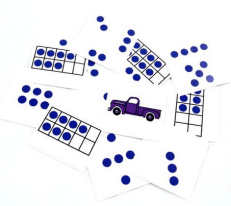
Whatever cards you choose to use, make sure they are appropriate for the level of the learner!!!

Game: Making Ten

Tiny Human Perspectives: What About 0?

What is up with 0? It is nothing, nada, zilch. So why spend time thinking about nothing?

While playing a game with dice (labeled 0-5 each), pre-schoolers had no trouble thinking about zero as nothing.

Student (rolls a 0 and 5): 0 and 5 is still 5!

Me: Why is it 5?

Student (now rolling eyes): Because you added nothing to 5, so it stays 5. You didn’t do anything to it! (Duh…Mrs. M!)

Playing the same game in Kindergarten. Out of 20 students, only 2 (one being my son, since he already struggled with it at home and had made some headway with clarifying what happens when you add 0) students were okay not changing the value of the addend when added to 0. The others added at least one more to their addend, or just sat there and said they lost a turn because they got a 0. ????

Why the struggle?

Students use their instincts when learning. While playing (without formal teaching), the preschoolers made sense of the zero. When you add nothing to a number, it stays the same (AKA Additive Identity Property). However, this ‘sense-making’ was left behind once (I will use my son as the example) Chris started learning addition. He figured out that when you add numbers, the value changes. Every problem he did resulted in a larger value than the two addends. Mama, it gets bigger as you add. When he rolled a 0, he couldn’t make sense of that with his understanding of what addition IS. We had to roll LOTS of 0’s before he finally clicked that adding nothing doesn’t change the other addend.

What Can You Do?

Allow you child to play with a die that has a 0. Allow them to make sense of this new phenomena and open their eyes to new learnings about addition. This will help them later, when adding different kinds of numbers (like negatives) results in smaller sums.

Remember, Zero really is a Hero!

Tiny Human Perspectives: What About 0?

War!(HUH!) What is it good for? (Absolutely lots in Math!)

With my family on the go so much during the non-lazy days of summer, we need easy games to entertain the tiny humans that don’t require mass amounts of attention from the adults (who are often in conversation). Enter the game of War. This versatile game can be used for all age groups and can really keep your child’s skills in arithmetic in check during the “summer slump”.

How to Play (Basic Version)

  1. Grab a deck of cards (I keep one in my purse and in the car at all times). You don’t have to, but I prefer to take out the face cards and jokers. Shuffle the rest and divvy out to all who are playing.
  2. All players shove all of their cards into a “deck” and keeps the deck face down.
  3. All players (at the same time to avoid cheating) flip the first card. The player with the largest value is the winner and takes all of the cards in the round.IMG_5434
  4. If there is a tie (that is the largest value), those players place 3 cards on their original face down and flip the fourth card. Whichever player NOW has the largest value gets all of the cards from the round. IMG_5435
  5. Continue playing until either a) one player has all of the cards; or b) you get sick of playing. The player with the most cards is the winner.

Additional Versions

  • For younger players: Use only 2-5 from the decks and play with those. The game dot cardsgoes faster and they are working only with 2, 3, 4, and 5. You can use the aces as 1. Even better, use number cards or dot cards (see below for links). Print on cardstock (4 cards per number) or go online and buy a set.
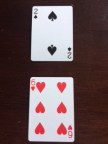
  • For any age: You can also play and whoever gets the smallest value wins. This is great for preK-1st graders!
  • For students who need review with addition: Play two cards at a time and add them. The player with the largest sum is the winner of the round.
  • For students who need review with multiplication: Play two cards at a time and multiply them. The player with the largest product is the winner of the round.
  • For grades 5-7: red cards are negative values; black cards are positive values. Flip over one card. If I have a red 6 and you have a black 2, you are the winner since positive values are always greater than negatives. IMG_5434
  • For grades 6-8 (or 7-8 if using Common Core): Play two cards and add them, using reds as negatives and blacks as positives. The player with the largest sum is the winner of the round.
  • For grades 6-8 (or 7-8 if using Common Core): Play two cards and multiply them, using reds as negatives and blacks as positives. The player with the largest product is the winner of the round.
  • For grades 6-8, use only values ace (for 1) through 5. Flip the first card; that is your base. Flip the second card; that is your exponent. The player with the highest value wins  the round.

Different Sets of Cards:

  • You could probably look on Amazon for different card types, but I love the sets at 52 Pickup. They are of high quality and there are many different types ranging from dot cards to ten frames to cards that go through the thousands (so you can work on place value!)

https://sumboxes.com/collections/types?q=52%20Pickup%20Card%20Decks


War!(HUH!) What is it good for? (Absolutely lots in Math!)

How Many Are Hiding?

This is a great game for tiny humans in need of some entertainment while waiting at a restaurant. Just make sure to ask for an extra children’s cup to play.

Age Level: 3-6 year olds

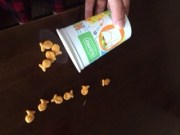
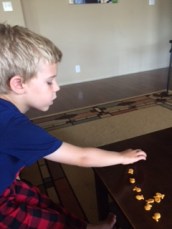
Materials: children’s plastic cup (any cup will do, just not transparent), a set of objects (I used goldfish for the example, as that was what was in my purse! Other options are pennies, beans, tiny annoying toys, etc.)

How to Play: Place out a certain number of ‘stuff’. Normally for me, it is however many I have in my purse! I would recommend starting with 5 or less, see how they do, and adjust as needed. The first time I played with my 5 year old, we started with 10 and it was quite frustrating for him. They catch on and you can up the number as they grow!

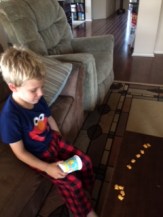
  1. Have your child count how many there are. IMG_5269
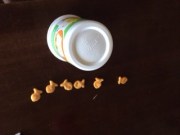
  2. Have your child close his/her eyes. Hide some of the objects under the cup.IMG_5276      IMG_5275
  3. Ask your child to open his/her eyes. Ask the following:
    1. How many do you see?
    2. If there were _________ to start with, how many are hiding?
  4. Allow your child to check their answer by lifting the cup.
  5. Ask the following:IMG_5274
    1. How many were hiding?
    2. How many were out?
    3. How many in all? (Woah! It is the same as what we started with! Weird!)
  6. Switch who hides and who plays.

Why play? Aside from counting one-by-one and ‘holding’ that number in their heads, students need lots of practice understanding that a number can represent an amount. That amount can be broken into parts (decomposed), but when we put them together (add them) they make the original number we had. This is part of the idea of conservation, which is critical for young mathematicians to understand (not the word but the idea) in order to add and subtract numbers.

Special thanks to my tiny human for playing this morning! Love ya, bud!


How Many Are Hiding?

Cool Tools for Kids in Math

Happy Mother’s Day AND Teacher Appreciation! Here are my gifts to you: FREE APPS and Sites to help your children (and students) learn math!!! Read on!

These past three days I got to geek it up at the NCTM annual conference in San Francisco. I have gone to several annual conferences, but this was the first time I worked in an exhibitor booth rather than attending as a participant. I was excited to be on the other side of the conference scene, but sad that I wasn’t sitting on the carpet (like so many) scouring the magazine o’ options for the perfect sessions.

As a teacher, I would ditch the exposition hall (except to get the free Legos and swag for my boys!) and attend every session I could. I would take copious notes, trying hard not to miss anything that was said in case THAT was my take away for the trip. Those fabulous notebooks that I poured my 72 hours of the conference into gather dust in a box in the garage. Don’t get me wrong; I would typically use 3-5 ideas/worksheets/tasks/quotes per conference. But was that worth the hours I sat in the back of a crowded room? Was there more to the conference than the sessions?

YES! This year I attended a single 60 min session and got several great ideas for a district I work with. The rest of my time was spent in the exhibition hall talking to reps (and long-time friends!), discussing mathematics, and truly learning from one another in a more intimate setting. I learned so much in these conversations, AND spent time at many vendor booths playing with the technology that I believe can truly make a difference in how students view mathematics. Though I am still grappling with the lack of notes in my handy-dandy notebook, I feel I am leaving with far more applicable ideas and tools than ever before!

The links below are (free!) sites you and your child can explore to really learn mathematics. They allow students to truly see what is going on and why the math “is what it is”. I hope this summer you are able to spend some time on these sites and give your students an opportunity to open up mathematics in amazing ways.  

Note to teachers: These are open source and free to use on your devices at school. You are welcome!

NumFu: http://www.origoeducation.com/num-fu/?mageloc=USnum fu

Currently their Mastering Addition Facts app is free. Get it now before they change this! Students work on their math facts in a developmental way, understanding as they gain mastery. (They do have a multiplication app as well, but it is not free.)


DESMOS: https://www.desmos.com/Desmos 2

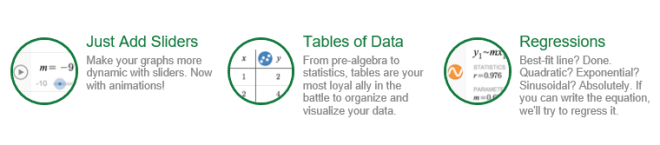
This is a site that allows you to graph functions, plot tables of data, evaluate equations, explore transformations, and much more! Desmos


GeogebraGeogebra: http://www.geogebra.org/

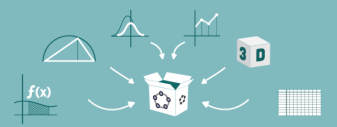
Geogebra makes a link between geometry and algebra using visual representations students can manipulate and finally see what is going on mathematically.Geogebra 2


math Learning centerMath Learning Center: http://mathlearningcenter.org/apps

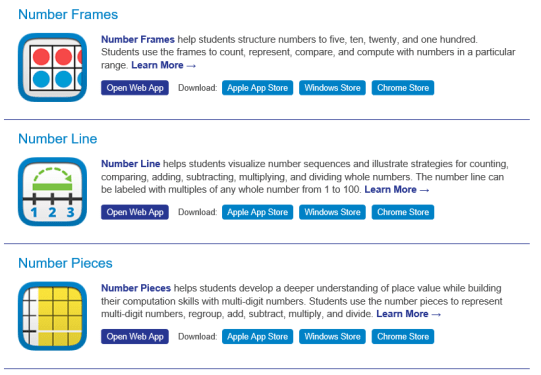
These apps are amazing! So many to choose from to help students conceptually understand mathematics. There are number lines, geoboards, money pieces with a number rack, rekenreks, ten frames, pattern blocks and more! Just allowing your child to play with these apps will enhance their understanding of number! Here are just a few from the site:math learning center 2

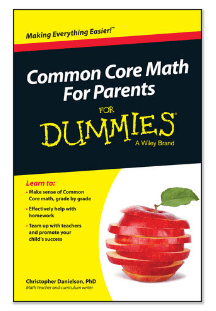
 Finally, this is a book that came highly recommended. Though not free, it can be a support for parents in navigating Common Core mathematics. (It does come with videos as well!)CCSS Math

http://www.amazon.com/Common-Parents-Dummies-Videos-Online/dp/1119013933

Cool Tools for Kids in Math

When Their Normal Is Not Our Normal

I have the honor of working one-on-one with a couple of kiddos in my neighborhood. One young lady (we will call her L) in particular LOVES doing number talks with me. She is brilliant but has a difficult time memorizing facts. And, like so many of our children in this country, since she can’t do her math facts quickly, she gets frustrated and just doesn’t do the math. Number talks have freed L with numbers. She has been given liberty to work them the way that make sense to her. It may take a second or two longer, but the creativity and use of properties (unbeknownst to her) she uses far exceeds the simple memorization of basic facts.

A few days ago I went over to L’s home to work with her on number talks (see below for more information). We had to change our agenda, as she was given over 20 problems involving perimeter. (TEACHER NOTE!!! I get it; we want to provide practice for students to understand what perimeter is on lots of different polygons. However, if that is the purpose, then choose friendly numbers so students who struggle don’t get caught up in the arithmetic and can focus on the concept.) L was not happy about it; she was waiting to do the math she loves and is good at. The homework is not something she intended to do with Miss Jen.

I pulled out my whiteboard and explained we would still do the number talks, but through the homework problems. We started with the ‘easy’ ones; ones that she felt confident she could do in her head. Note: L loves using a number line (visual learner) and chose to do most of the friendly number problems with that model.

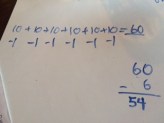
Then we got to the ones with a 9 in the ones digit. IMG_8043In fact, it was a regular hexagon with a side length of 9 units. Now if L knew multiplication, that would be great, but adding 6 of the 9’s would not be easy. So we discussed what is an easy number to use instead of 9. “10! Oooh I can do six tens (60) and subtract 1 for each ten I used!” She loved it. She even applied it to the hexagon with a side of 19 units. “I can make them 20 and subtract 1 for each 20! Easy!”  IMG_8045

L was even able to create friendly problems out of 16’s. “I can use a 15 and add 1 to each. That is simple.” It was honestly more fun to do the difficult problems than the mental math ones, simply because she had control of the numbers to use.

So what mathematics was supported beyond perimeter? She was able to decompose numbers and recompose them. She understood that she could use different strategies and models depending on the number choices. I think the most important piece was that she had control. She wasn’t a robot, doing a ton of problems the same way. She controlled the numbers being used, confined only to the conservation of the original number. So for example, instead of using a 6, she used a 5, but knew she needed to add one for each five she used to conserve the given 6.

How does this help you as a parent? Play with numbers with your kids! Let them explore! So if I am adding 6 + 6, is that the same as 5 + 5 + 1 + 1? Why??? (Communitive Property and understanding I can switch the addends around to make 5 + 1 + 5 + 1 which gets me back to 6 + 6.)

What about the 9’s (always tough to add with that digit). Could I use 10’s instead? So for example, instead of 8 + 9, could I add 8 + 10, then subtract 1? (8 + 10 = 18; 18 – 1 = 17. Yes!) What about 199 + 56? I could add 200 + 56 first, then subtract 1 to get me back to 199. So 200 + 56 = 256; 256 – 1 = 255. Sweet!

As parents, this is not our normal. But why not let it be their normal? Let them explore and find ways to add and subtract numbers to make it easier. After all, our standard procedures stem from mathematicians playing and exploring with numbers until he/she found a pattern that worked everytime. Why not let your child be a little mathematician and explore for himself/herself?

IMG_8051Note: The pic of L is her final message to me before I left.  Her normal is not our normal; her normal is way more fun (as math should be!).

For more information on number talks (free!)http://www.mathperspectives.com/pdf_docs/number_talks.pdf

The book I use to teach number talks (not free)                     http://store.mathsolutions.com/product-info.php?Number-Talks-pid270.html


When Their Normal Is Not Our Normal

Response to Confusion 43-13

So today a friend tagged me in a FB post regarding the “frightening” method that students MUST solve subtraction problems. I have posted the link below, and I believe the link is at the bottom of this post as well! Take a look.

So let’s summarize the tutor’s concerns. 1. That we are writing problems horizontally rather than vertically. 2. That students are using a strategy of “adding up” rather than “stack and subtract”. 3. They MUST use this strategy and no other.

I would like to address each of these and provide some comments.

  1. Most of us are used to seeing math problems vertically. Why? Well, for one, it makes the problem ready to go for  the algorithm  of “stack and subtract” (which is not the ONLY algorithm in the world, mind you). I would contend it also saves space for publishing companies in their workbooks. If the problem is already written for the algorithm, publishers do not have to provide additional space and therefore can fit more problems on a page, and save money. (Yeah, I went there. Bring on the comments!) However, when you write a subtraction problem vertically, you lose the essence of the numbers.   IMG_7211Here I only see single digit subtracted by single digit. I do not see 40 – 20, but 4 – 2 and 5 – 1. This is okay for problems where we do not have regrouping. However, some students get so stuck in the process of regrouping that they no longer see the value of the places and just write a very ‘random’ value as the difference. When I write the problem horizontally (45-21), it allows me to view it from a place value perspective. My eyes look first at the tens and then the ones, versus the horizontal example where I start with the ones and then look at the tens. Also, writing it horizontally does not constrict me to a “stack and subtract” method. (See prior blog for more info on great subtraction strategies to help kiddos.) Really, both are fine; no need to get all uppity about it. And if a teacher says they HAVE  to write it that way, it is not true, but what is true is that they learn to think about relationships and different strategies using place value and properties of numbers BEFORE learning the standard algorithm. In fact, the standard algorithm for multi-digit subtraction should not be mastered until grade 3: CCSS.Math.Content.3.NBT.A.2
    Fluently add and subtract within 1000 using strategies and algorithms based on place value, properties of operations, and/or the relationship between addition and subtraction. So students have lots and lots of time to process what it means to subtract and its relationship to addition.
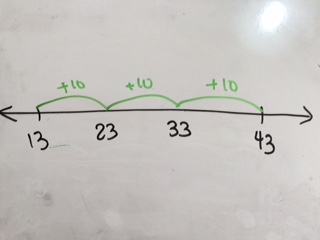
  2. (and 3.) Adding up is one strategy students can use. Makes sense to me! If I already know how to add, I can simply use that to help me figure out the missing addend. This is all a subtraction problem really is: a missing addend problem! Consider the following: 43 – 16. This is really finding out 16 + ____ = 43. Now typically, students do not need to go to the next five as the tutor suggests. And really a number line is FABULOUS for modeling adding up. Here is one way to get the value. IMG_7213Notice this is a great strategy for students who struggle with regrouping, because there IS NO REGROUPING!!!  I went up 4 to the nearest ten (20), added 20 more (40), and ‘hopped’ 3 more to get to my end point (43). 4 + 20 + 3 is 27. Therefore, 43 -16 = 27.                                                               Using the tutor’s problem (43-13), I think adding up is efficient, if you move up by tens. I can simply add by tensIMG_7214 until I reach 43. 3-tens is 30. Not sure why it is so convoluted in her explanation and NO! Students do not have to add up the same way the tutor did. In fact, that is the wonderful thing about Common Core. CCSS.Math.Content.2.NBT.B.7
    Add and subtract within 1000, using concrete models or drawings and strategies based on place value, properties of operations, and/or the relationship between addition and subtraction; relate the strategy to a written method. Understand that in adding or subtracting three-digit numbers, one adds or subtracts hundreds and hundreds, tens and tens, ones and ones; and sometimes it is necessary to compose or decompose tens or hundreds. Notice that students can use any method, with or without drawings or concrete models!!! Super awesome! Hooray for creativity! I no longer have to use one method (that I don’t really get and just memorized because my teacher told me to); I can use any method so long as I keep in mind place value and my rules (properties).
“Our classrooms are filled with students and adults who think of mathematics as rules and procedures to memorize without understanding the numerical relationships that provide the foundation for these rules. The teaching of mathematics has been viewed as a discrete set of rules and procedures to be implemented with speed and accuracy but without necessarily understanding mathematical logic. For the majority of our nation, knowledge of mathematical rules has not allowed them to use math confidently in their daily lives. With almost two-thirds of the nation’s adult population fearful of mathematics, they have simply said “NO” to math and closed the doors to careers that require higher math” (Burns, 1998; Parrish, 2010).
Let’s allow students to make sense of number relationships, what the operations MEAN, and figure out what makes sense and how to approach the mathematics based on the numbers given.


Response to Confusion 43-13

3 Common Subtraction Strategies

A dear friend had this posted last night:

1509183_10208482214599412_3676246263346474226_nWhy?! Why would I even consider doing simple subtraction like this?! It’s about 10 steps too many, not to mention super confusing!!!

And to be honest, I had to look at the first problem (represented as a “tape diagram”) to figure out what they were asking.  So my next blog will be about the difference between CCSS standards and how they are being implemented (often poorly). Today is to help out my friend…

So, back in the day we were given a set of procedures to follow step-by-step. We never really knew why (or at least I didn’t): just follow the magical steps in order and it will produce a number that your teacher will smile at and say you are smart. If you did not follow the steps correctly, then have fun with extra practice and staying in during lunch.

CCSS is reversing this. They are allowing students (through research-based strategies kids naturally use) to explore a variety of ways to solve problems. From there, in grade 4 they will generate the traditional algorithm. It hasn’t gone away; it is just the end of the journey.

Here are 3 of the most used strategies for kiddos in subtraction.

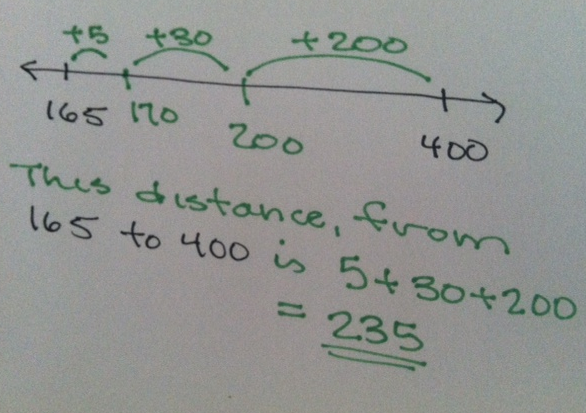
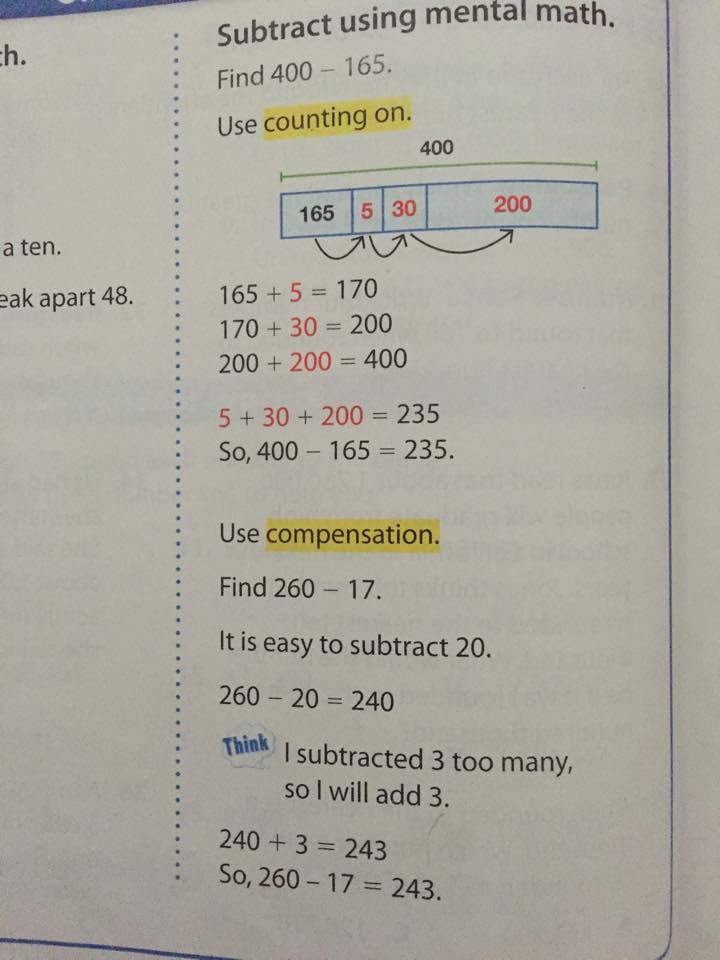
1. Count Up. Makes sense. We spend so much time teaching how to add. Why not use it? A subtraction problem is considered a “missing addend” problem.

One of the ways to represent counting up is on an open number line. This is the one the above pic shows on a tape diagram. So you are finding how far (the distance between) it is from one value to the next.

Typically, kids will add up to the nearest ten, then hundred, and jump until they get to the number they need. Add up all of the “hops” you did and that is the distance.

28 - 9 number line

28 – 9

Think about it as, “What plus 9 makes 28?

Or  “How far must I go to get from 9 to 28?

400 - 165 number line

400-165

Think about it as “What plus 165 makes 400?

Or “How far do I have to go to get from 165 to 400?

This is my favorite strategy, because it takes the “borrowing” out of the math. (Why is it called “borrowing”? You will never give it back.)

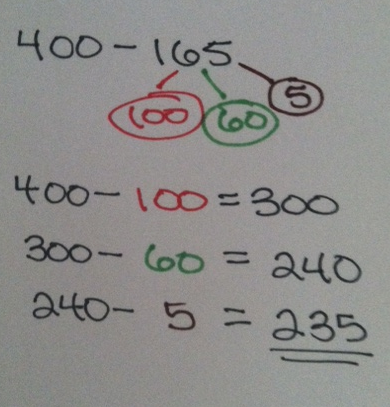
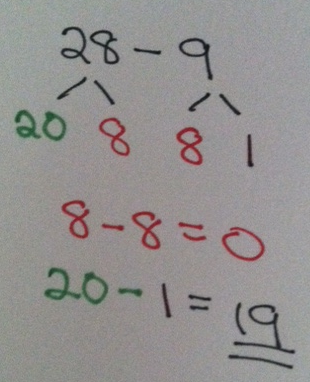
2. Decompose the subtrahend. Name it what you want. You will break apart the second number in the subtraction problem to make it easier to subtract. This is typically shown by a number bond.

28 - 9 number bond28 – 9     

Break apart the 9 into 8 and 1. (9 = 8+1)

This allows the student to subtract the same amount of ones from ones first (8 – 8). The leftover ones (in this case, 1) can be taken away second. Again, a great strategy when the subtrahend (the second number in the subtraction problem) has a digit larger than the minuhend (the first number).

400 - 165 number bond

400-165

Break apart the 165 by place value (165 = 100+60+5).

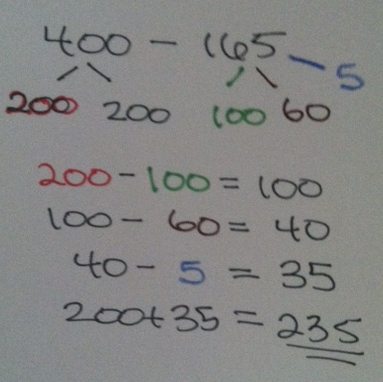
This is typically a strategy that works well in your head, versus the complexity of seeing it written out mathematically. Trust me when I say that kids can do this quickly in their head; writing what they did is much harder (and much harder for us to figure out what the heck they did). You do have to know the ways to make 10’s and 100’s. So I have to know that 60 + 40 = 100 (or 6 tens + 4 tens = 10 tens = 100) to know that 300 – 60 = 240. This is the second grade standard; subtracting multiples of tens. (BTW: This is the one that gets blasted on Facebook. I have seen students use this strategy in their head time and time again. The minute we record their thinking mathematically, people get all out of whack. It is not more steps than the standard algorithm. The moves you make are written as equations using place value rather than little meaningless tick marks at the top of the problem.

 3. Solve using place value. Similar to the second strategy, but you can break both numbers up as you choose.

28 - 9 decompose28 – 9

Again, looks a lot scarier when I record it this way. Using a number bond is a great visual, and typically the student starts this process by just saying what they want to subtract verbally, rather than writing all of the notation down.

400 - 165 decompose400 – 165

I am just showing one way to break apart the values. When I asked my son how he would do it, he said he would break up 400 into 100 + 100 + 200. That made sense to him, and in the end that is what we want. For students to use a strategy and make sense of it.

You will find that one strategy works with the numbers given better than another. For example, with the 400 – 165, I would use a counting up. With 28 – 9, I like the break up the subtrahend. The point of it all is for students to really understand what is happening when they subtract. Where is the “borrowing” or “regrouping” happening, so when they learn the traditional algorithm, it is an extension of their learning rather than some random tick mark step-by-step formula.

Continue reading “3 Common Subtraction Strategies”

3 Common Subtraction Strategies

Why Distribute in Third Grade?

I am blessed to work with dedicated teachers who care deeply for their students and are working hard to understand the conceptual shifts CCSS brings to the table in math. One such teacher emailed me this weekend distraught, not knowing how to respond to a frustrated parent. The premise was the mother did not understand why her third grader was being asked to learn the distributive property, when she herself hadn’t learned it until Algebra I.

The arithmetic properties (commutative, associative, identities, etc.) were not created for Algebra I, though many of us didn’t learn them until then. I remember thinking that a bunch of old guys must have made them up for the sheer joy of torturing me into memorizing random stuff. No, the properties are the rules that give us the freedom to simplify math problems to make them easier to calculate while keeping the value the same.

An example. Which would be easier to solve in your head, 15 + 29 then add 5  OR  15 + 5 then add 29? The second, because we can make tens (15+5 = 20) and easily add 29 to it rather than have to “carry the 1” on the first example. This illustrates the commutative property: when adding or multiplying, I can perform that operation with any numbers in the problem first. I can switch the numbers around to make the problem easier to add (or multiply).

These properties should be celebrated as early as Kindergarten. Students do not necessarily need to know the names, but should realize through exploration that they exist and help them find their values.

Back to the distributive property. We old-timers saw it used like this: 6(5x + 2) = 30x + 12. This is not what we are asking third graders to do! Since the CCSSM standards require single digit multiplication fluency in third grade (1×1 through 9×9), it is natural to teach the distributive property at this level. This property allows me to break up one of my bigger numbers into parts. I can then multiply those smaller parts by the other factor to make it easier.

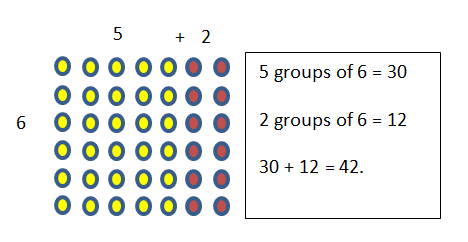
6 x 7 arrayExample: 6 x 7   This is always a toughie. Is it 48? 42? 56? I don’t know! Even if I draw an array (the above pic), that is a whole lot of dots to count!

But if I know my 5’s and 2’s, I can figure it out using the distributive property!             Break up the 7 into 5 and 2.   So now 6 x 7 becomes 6 x (5 + 2).    distribute array 6 x 7

I know 6 x 5 = 30.  (This is illustrated in yellow.)

I know 6 x 2 = 12 (This is illustrated in red.)

So 6 x (5 + 2) = 30 + 12 = 42.

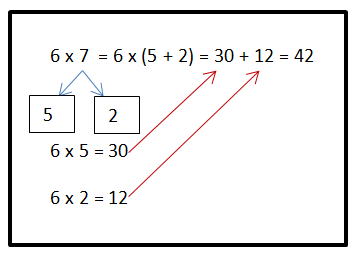
distributive property 6 x 7

You may also see the distributive property used as a “number bond”. This is when it is broken up into parts, either using boxes or circles to show the parts. In this case, 7 is broken up into two parts:  5 and 2.

Utilizing the distributive property is an amazing strategy for students who struggle with memorization! They can use the distributive property to break up larger values they don’t know the multiplication facts for, until they have time to build fluency. More important, it teaches kids the value of knowing that math isn’t just memorization. There are structures and patterns that I can use. If I know the rules that govern those patterns (the properties), I can change the structure to find the value in an easier way. 

Why Distribute in Third Grade?

My Nightmare Learning Algorithms (And Why I Am Thrilled We Now Encourage Multiple Strategies!)

CCSS math debunkIf you are on Facebook, you have seen this (or one similar to it), usually followed by stating that a certain set of standards are evil and we should be teaching the kids drill and kill through the “right way”. So let’s clear the air (Or let me fill it with hot air and you can comment below. Bring it on!).

To start,  “our way” is not the way of all. The step and structure with which we add, subtract, multiply and divide are not used by all countries. In fact, these methods are just some of the many ways students can simplify problems using these four operations. The ones we traditionally use are examples of “algorithms”. If used correctly, each will work for different number types and you can get “the right answer” pretty quickly if you have had lots of practice with them.

CCSS math debunk 3BUT THEY ARE NOT THE ONLY ONES! And I would fight the good fight that there are MUCH easier ways to get to the value using other strategies. I will even throw myself under the bus and tell you that I do not use the traditional multiplication algorithm. I make too many mistakes when I use it. I know it, but there is another method that works just as fast for me, and I get the correct value using it. And long division? Ugh. Why not just start with something I know, chunk it out, and get to easier numbers??? May look a bit odd, but still it is faster than sitting there trying to find out how many times one value goes into another (More on this division idea in an upcoming post for all you 4-6th grade parents!).

So think back to your elementary days. How many days were spent drilling the algorithms you now know (or pretend to know since you use a calculator instead)? How many hours? For me, it was a nightmare. I didn’t get them. I didn’t know when to move a little 1 (And why was it so tiny if it meant a bigger number???) in addition, why we crossed out stuff on top and not only moved it over, but made a double digit number in subtraction (What happened to my little 1 friend in addition? Where did she go???), when to put an “X” and why the heck were we even using an X in multiplication when it isn’t even a number, and so on. I was confused, and I covered it up by checking with a calculator and fixing each line to pretend I knew what I was doing. It was horrible, and I felt stupid, slow and sad.

CCSS math debunk 2I had my a-ha moment in seventh grade. (So it took EIGHT YEARS to finally figure it out.) My math teacher took me out of science, my favorite class mind you, to have a double dose of math. (Great. Now I get to hate it twice as long.) However, he started showing me other ways to do the math. What other countries and cultures were using to figure out the exact same problems, but with visuals and graphic organizers and all kinds of craziness. It was wonderful. It was a breath of fresh air. It was my lifeline to true mathematics.

You see, math isn’t just about calculating. I think of mathematics as finding patterns and relationships in and among quantitative items, and using those patterns and relationships to create rules, strategies and “algorithms”, prove or disprove others (And my own!) rules and algorithms, and figure out how the world works on a quantitative scale. It is beautiful. It is elegant. It makes life make sense.

Keep in mind, the standards DO say for students to eventually use our traditional algorithms as ONE STRATEGY for finding the values. But it is at the end of their journey of understanding. It is the final step of a long walk through discovery; using manipulatives, moving to visual representations, conjecturing student-strategies (whether they work all the time or not), and finally moving into the algorithm you all claim to know and love.

puzzle piecesThink of a puzzle. My husband starts with the border. I start with the middle and the pieces that have the same color or object. Yet we will both finish the puzzle, even though we went at putting it together differently.  Some of the representations will be easy for your child, others a bit more difficult until they understand how they are relating to the operation. Yet, they will get to the end and finish the puzzle, even if his struggles are different than another’s. That is why working together is so important. We can help each other make sense and persevere to the end!

So, at the beginning of another school year, take a deep breath. Give different models and strategies a chance. Ask for help in understanding how the strategies or models work and their significance to understanding an operation (Send ME questions and problems!!!!). Encourage your child to try something new, and be supportive. As the child who needed something different, I thank you. 🙂

My Nightmare Learning Algorithms (And Why I Am Thrilled We Now Encourage Multiple Strategies!)