Beyond Counting: Ideas and Activites For Your Little Ones

While waiting for his big brother at the orthodontist, my little boy, C,  had the following conversation…

Dr. T: How old are you, cutie?

C: I’m three!

Dr. T: How old is your brother (pointing towards my thirteen year old)

C: Four!

This was such a proud mama moment for me!

Now you may ask yourself, “Why is she getting all excited over this? Clearly, he is not four. Why is she so proud of her little boy?”

There are a number of reasons why this is a critical step towards numeracy. I truly believe that if you start children purposefully thinking about numbers early on, their chance for success in mathematics increases dramatically. So let’s highlight a few of the big ideas C is working towards.
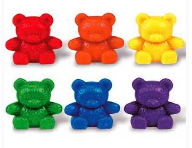
bears

1. Cardinality– This is the idea that the number being used is measuring some amount. It answers the question, “How many?” For example, I can ask my son, “How many bears do you see?” He would count them one by one until he got to the number six. That last number, 6, tells you the number of bears in the set. This is a big deal! The child is no longer counting from memorization; he is recognizing that the number relates to a certain amount of “things”. The more things you have, the further you have to count. C recognized that his brother was older (or “bigger”). Therefore, his brother was tagged to a number after the one he identified with, three. He did not know how many more to go, just that he had to choose a number beyond his own. Cool.

2. Inclusion– This is the idea that the number labeling “how many objects” in a group includes all of the preceding numbers. So even though we have six bears, we can also think of it as “one and some more”, “two and some more”, “three and some more”, and so on. This is critical for addition and subtraction. If I have the number 14, I can think about it as “ten and four more”, which helps me when I want to add or subtract and regroup to make the problem easier. C knew that his brother was older, and therefore had to include his age (three) and some more. Again, he isn’t at the point of knowing how much more, but is on his way. Awesome.

3. Magnitude– The size of the object. In this case, a number (or value) given to a quantity (age) for the purpose of comparing with another quantity. This idea is instrumental for estimation, particularly with very large and very small numbers. In fact, one of the posts requested of me to write is helping students compare fractions. If a child does not know the relative size of the number they are considering then it is very difficult to compare, operate or manipulate it with any real fluency or number sense. How do I know my answer is reasonable if I haven’t a clue what the numbers I am working with represent??? For C, he was able to recognize that his brother had to be a larger quantity than three, because he is older. Super rad!

These three ideas are certainly related, but each has a different feel. You can work with them simultaneously, so long as there is purpose to the questions and tasks you present to your kids. Below are some simple, but powerful, activities you can play with your little ones to build these concepts. I choose the games that you can take on the road, to the doctor’s office, to a restaurant, etc. Instead of sitting around being squirrelly, play a game while you wait. Even five minutes will have a significant impact!

1. Count and Check: Grab a handful of ANYTHING (balls, pennies, beans, cheerios, etc) and ask your child to count how many. Make sure the amount of objects is appropriate. (For example, C is working on objects through 5.) When he finishes counting the last object, ask, “How many _____ are there?” If he cannot answer, that is okay! He is working towards cardinality. He is able to say the objects one by one (which is called one to one correspondence), but hasn’t figured out that the last number he says represents the entire amount. Have him count again, and ask again. If he cannot answer again, say, “There are (say the amount) ______ here.”  You can play this at the grocery store (count the apples, bananas, etc), setting the table (How many forks?), etc.

2. Match Me! Grab a die (one dice) and a handful of ANYTHING in a baggie. (I typically do this with pennies at restaurant.) Have your child roll the die. Let’s say she rolls a five. She takes out that many pennies and lays them out for you to see. Ask her to count them one-by-one to make sure she has five. At the end ask, “How many pennies do you have?” If she doesn’t know, that is okay! Have her recount, then ask again. If she still isn’t able to tell you, say, “I see you have five pennies.” Make sure you roll next and model for your child. Take turns until you get bored or dinner comes!

To bring the difficulty up, after playing each of these, ask, “If I gave you one more item, how many would you have?” This brings in the concepts of magnitude and inclusion! If your child has to recount with one more added in, that is fine! You know he’s got it when he can answer quickly without physically adding in another item and recounting.

Need another level of difficulty? Ask, “If I took away one of the items, how many will be left?” Same idea, but working backwards, and just as important!

Beyond Counting: Ideas and Activites For Your Little Ones

Learning Multiplication Facts Fluently: Resources

I  was hoping to have this post up a few days ago. However, I have been deeply disappointed with the lack of resources for students to truly gain an understanding of what multiplication IS. My least favorite involved rhymes for EVERY fact that had absolutely nothing to do with multiplication! (4 door x 6 chicks= denty floor, 24. Are you kidding me????)

There are a ton of “just fact” games: give the fact, type in the product, and so on. And these are fine for students who already know their facts. But if your child is struggling to learn their multiplication facts, that is the LAST place you want to go! So I am going to provide some alternatives for you to explore.

Before I do, I want you to truly ask yourself this question. Does your child REALLY know the facts, or is she merely skip counting quickly? This question could also be asked of your first grader with addition. (Does he really know his addition facts, or is he counting by ones really fast?) When you ask your child a multiplication fact, does she tap it out, count on her fingers, or (what my middle school students would do ) bounce through the multiples? Let me give you an example: 3 x 7. Does your child bounce through (3, 6, 9, 12, 15, 18, 21…21!)? If so, she was timed too early in learning her multiplication facts. Your child should not be timed until she can use a strategy or just knows the fact within three seconds. And that is one-one thousand, two-one thousand, three-one thousand. Once they can multiply that quickly, you can go to some of these fun blast ‘em multiplication games.

So how can you help get her to three seconds? Here are three games I used with my son. I used them in this order, as they get more difficult and begin to have a sort of time crunch to them. If you have others, especially great apps, please include them in the comments section. If you add a resource, please let us know if it is to review mastery or to build strategies towards mastery. Thanks!

1. Circles and Stars. I have seen this in a number of mathematics resources, but the one I love is from Marilyn Burns (see link below). This is slightly adapted. All you need are two dice, paper and a pencil (or whiteboard and marker, which is my personal choice).

Roll two dice. The first number tells you how many circles to draw. The second number tells you how many stars to draw in EACH circle. The total number of stars is your product. Play 5 rounds. The person with the most stars at the end of 5 rounds wins.

Example: Sam rolls a 3 and a 4. He draws 3 circles, with 4 stars in each circle. There are twelve stars in all. 3 x 4 = 12.

Take it one step further. Roll two dice. You choose which number represents the circles and which number represents the number of stars in EACH circle. At some point, you want to ask your child, “Does it matter?” “Will I get the same amount of stars in the total?” The answer is yes! However, 5 circles with 2 stars in each circle looks different than 2 circles with 5 stars in each circle. Yet they both give me 10 stars in all. This is a great place to discuss the commutative property. For multiplication (and addition), when I reverse the order of my factors (the numbers I am multiplying together), I will get the same result. So if your child knows 3 x 7, but thinks he doesn’t know 7 x 3, think again!

2. Math Boggle! I loved Boggle growing up. Shake up the letters, and try to find as many words as you could in the time allotted. This helped me a great deal with learning to spell. Well, we need to play with numbers just like we play with letters. We are just going to start with one fact, and try to figure out as many strategies in the time allotted to find the product (the answer to a multiplication problem). Your kids may know this as a “Number Talk” if their teacher uses them as warm-ups. (If not, encourage them to do so!)

Example: 5 x 6. You have five minutes to find as many different ways to get the value. Go!

  1. 5 + 5 + 5 + 5 + 5 + 5= 30 (Still reliable and true, but not the fastest method.)
  2. 6 + 6 + 6 + 6 + 6 = 30 (Great to have a discussion as to which method, a or b, is more efficient and discuss the commutative property yet again.)
  3. 5 x (2 x 3) = 10 x 3 = 30 (I factored the 6 into 2 x 3. You know it as taking the prime factorization of 4. It’s actually a useful tool when working with multiplication and division.)
  4. 5 x (3 + 3) = (5 x 3) + (5 + 3) = 15 + 15 = 30. This is using the distributive property. Please see prior post for details! Also notice it is 15 twice, which could lead to the next strategy.
  5. 5 x (3 x 2) = 15 x 2 = 30. Similar to c, but using the commutative property. Also, similar to d, as I have 15 two times. This leads to a nice discussion about why we break apart the 6 instead of the 5. The number 6 is composite; it can be broken into the product of primes. 5 is prime, so it cannot be broken down into smaller whole numbers through multiplication.
  6. 5 x (4 + 2) = (5 x 4) + (5 x 2) = 20 + 10 = 30. Again, using distributive property, but I broke up the 6 differently.
  7. 5 x (5 + 1) = 25 + 5 = 30. Distributive property. Notice I stopped writing in the middle step. Once kids understand what is going on (in this case, I am multiplying the 5 times the 5 and then the 5 times the 1), they can omit this step. The goal is to get as many as you can. Further, we are eventually wanting them to do most of this in their head so they know their facts.
  8. (2 + 3) x 6 = (2 x 6) + (3 x 6) = 12 + 18 = 30. You can use distributive property by breaking up the 5, but notice the partial products you get (12 and 18) are tougher to add together in your head. Great place to talk about why we naturally break apart the 6 instead of the 5.
  9. There are many others, but I am hoping you get the idea.

You can play this all day long! Just use a whiteboard and work as a team. Take 5 minutes to work alone. Discuss all of the different strategies each of you used. Perhaps work together to find one more. Go to a different fact. Play in the car (Obviously the kids are playing, not you while driving!), while waiting for an appointment, at a restaurant. The more you play with numbers with your kids, the more fun they have, and the more important they see numbers playing a role in their lives.

3. The Product Game: http://illuminations.nctm.org/Lesson.aspx?id=5729

This is the first of four different multiplication activities your child can do with you to learn multiplication fluently. I highly recommend playing this after your child has really worked with the first two activities. The directions are included on the site as well as a pdf of the game you can print out. You are basically taking two numbers and multiplying them together to earn a spot on the grid. The first person to get four in a row (like tic-tac-toe), wins. Have a whiteboard or scratch paper handy in case your child wants to use some of their strategies to figure out the products. The other activities can be found through this link: http://illuminations.nctm.org/unit.aspx?id=6104

If you only have time or energy for one of these three activities, please use #2. It gets you the most bang for your buck. Happy number playing!!!


Teachers: For a great resource for multiplication please check out Lessons for Introducing Multiplication, Grade 3 by Marilyn Burns (2001)


Learning Multiplication Facts Fluently: Resources

Fluency in Multiplication: Why Your Child Needs To Know How to Distribute!

This is the third in a series regarding fluency of basic facts. For the introduction to this series, please read Fluency and Memorization Are Not Synonyms!!!

I am a believer that all students can be successful in understanding mathematics. Maybe not memorizing erronerous facts, but truly understanding what the numbers mean and how they relate to one another. One of my favorite interviews to do with my sixth graders is on multiplication facts. You may want to ask your child this question as well…

If I know that 7 x 6 is 42, how does that help me figure out what 7 x 7 is?

Most students will say “49”, but will not find the relationship between the two facts. Here are the common answers for my sixth graders:

1. “I just know it.”

2. (Counting each one on his/her fingers) “7, 14, 21, 28, (usually begins counting by ones), 29, 30, 31, 32, 33, 34, 35, 36, 37, 38, 39, 40, 41, 42, 49…7 x 7 is 49.”

3. Gets the answer wrong, or says he/she does not know that one.

Now don’t get me wrong, I am appreciative when a student “just knows it”, because it usually makes her life easier. The middle school years are ALLLL about multiplicative thinking and proportional reasoning. If you do not know your multiplication facts fluently, you spend sooo much time figuring out the fact (such as student #2) you get lost in the actual work you are trying to do. This leads to frustration, feelings of failure, and a negative attitude towards mathematics.

The answer I am looking for is similar to the following.

“I can just add one more group of 7 to 42 and get 49.”

Why is this important? Because many children do not see multiplication of whole numbers as simply a certain number of equal groups. 7 x 6 means that I either have 7 groups of 6 OR 6 groups of 7 (Commutative Property. Please see my blog on fluency with addition facts.) So if I have 7 x 7, I have one more group of 7 than I did before.

Mathematically, it looks like this: 7 x 7 =(7 x 6) + (7 x 1) = 42 (the fact I was given) + 7 = 49.

This type of strategy, doing your multiplication in parts, is often called in elementary books the partial products. In middle school, this particular set of partial products is called the distributive property. It means you are going to distribute (pass out) a number, multiplying it by everything it has a relationship to. This is not new. We used this in Algebra back in the day. But to use it to help with multiplication facts is a novel idea for most, though it brings understanding to what they are learning.

Here is another example: 6 x 9. (One of the most commonly missed facts.)

Let’s say I do not know my 9’s. However, I do know my x 10’s and my x 1’s. I can think about multiplying 6 by 9 as multiplying 6 by one less than 10, since 10 – 1 = 9.

6 x 9 = 6 x (10 – 1) (true)

So now I need to know how much 6 x 10 is and 6 x 1 is. (You are distributing the 6.) Those are easy facts for me!

6 x (10 – 1) = (6 x 10) – (6 x 1) = 60 – 6 = 54.

I can do this with any of the facts. Say your student struggles with 7’s. However, they know their 2’s and 5’s. They can break the 7 into 2 + 5 and use the distributive property.

4 x 7 = 4 x (2 + 5)

Now multiply 4 by the 2 and 4 by the 5 (You are distributing the 4.):

4 x (2 + 5) = (4 x 2) + (4 x 5) = 8 + 20 =28. Trust me, it looks a lot freakier on paper than just doing the partial products in your head!

Here is one for you to try: 8 x 7. Try it on paper before sneaking a peak!

There are several options. Here are a few. If yours isn’t here, please add it in the comments for others to see!

Option 1 (what I do): Break apart the 7 into 2 and 5.

8 x 7 = 8 x (2 + 5) = 16 + 40 = 56.

Option 2: Break apart the 8 into 4 and 4.

 8 x 7 = (4 + 4) x 7 = 28 + 28 = 56.

Option 3 (what my son does): Break apart the 8 into 10 – 2.

8 x 7 = (10 – 2) x 7 = 70 – 14 = 56.

There is no counting on your fingers, no tapping of feet or bopping of heads (which is what your child does to keep count if they don’t have the facts fluent yet). They just break up one of the factors (one of the numbers you are multiplying together) and multiply by parts. I really only need to know my 1’s, 2’s, 5’s and 10’s. Every other factor can be broken into these parts. It takes the number of multiplication facts to memorize from 100 (if you count 10’s) to 36.

Here’s why you really want to use this strategy with your child. If you are reading this, I bet your child is struggling with memorizing the facts. This strategy isn’t drill and kill. It isn’t a slower method that makes your child feel less than intelligent. It is actually a more sophisticated way to do the math, as it shows where the relationships are among the numbers. It is algebraic thinking in an arithmetic expression. The more your child “plays around” with numbers, the more relationships he/she will see, and the easier algebraic thinking will become. And yes, most (after using the distributive property over and over) will find that the facts will become automatic over time.

Let’s show a problem with a multi-digit number. (Another favorite of mine to use when interviewing children.) 6 x 199. Try it out. How would you solve it?

I just did it in my head. And no, I am not brilliant! Just using relationships to make the problem easier!

6 x 199 is the same as 6 x (200 – 1) = 1200 – 6 = 1194. Sooo much easier than trying to carry and multiply a bunch of numbers by 9!!!

I have to end this with a final thought. I have two dear friends that blatantly state they do not have their multiplication facts memorized. “It’s a waste of necessary brain space when all I need to know are my simple facts and build up the others in my head”, claimed the first. “Why do I need them memorized when I can figure it out quickly using partial products???” stated the second. What to know what their occupations are? The first is a mathematician and professor. The second is a statistician and psychologist. Hmmmm….

Next Blog: On-line resources and games/activities to build multiplication fluency!!!

Fluency in Multiplication: Why Your Child Needs To Know How to Distribute!

Basic Addition Facts For Fluency: Beyond Flash Cards!!!

This is the second of a series of blogs regarding fluency of basic facts.

Memorizing any operational facts can be easy for some (who have photographic memories) and difficult for others. I tried and tried every type of “flash card” with my oldest and all it did was provide frustration, tears, and dislike for the math. We tried flash cards, memory games, on-line shoot the sum games. And none of them worked. I freaked out, knowing that if he didn’t get these facts down, it would be an uphill battle. But is it really? Do we need to focus on memorization or understanding???

This blog is about understanding and a teeny tiny bit of memorization. Please feel free to disagree, as this is a blog after all and participation is encouraged! However, at least read on before fighting the fight for memorizing only.

Depending on whether you live in a Common Core state or not, typically we want children to know fluently all of their facts to five by the end of Kindergarten and all of their single digit facts (10 + 10 is cool too) by the end of grade 1. Note I wrote “fluently” versus “to automaticity”. So what’s the difference? It means I get three whole seconds to figure it out. I may not be able to see the answer in 0.5 seconds, but using some strategic thinking I can get it. That’s the goal. Anything beyond is cool, but this is for all children.

Fun fact: If all you are going to do is memorize the sums for two single digit numbers, the amount of facts you need to memorize is 81. 81! That is a LOT! Have fun making 81 flashcards! No thank you!

So let’s dwindle the amount to memorize. Below are two strategies to teach your kiddos to make that 81 significantly less. (There are others, but if you focus on these two you are waaay ahead of the game!)

  1. Commutativity. This is a property (a rule that ALWAYS works in mathematics) of equality. Think about the distance you drive to work. And the distance you drive home. Now if you take the same route both times, you go the same distance. No matter if you start from home, or you start from work, your commute distance is the same. Commutativity works the same for numbers. I can add 3 + 5 or 5+3 and my result (the sum) is the same, 8. So if I use my commutative property, I now only have to memorize one of the two facts! I am now down to 45 facts! (You may think, “Hey, why isn’t it half of 81?” Well, the doubles such as 2 + 2 and 3 + 3 do not numerically have a commutative fact, so you are stuck with them.)
  2. Making 10. This is a big stinking deal. Your kiddos need to get under their belt the ways to make ten. (1 + 9, 2 + 8, 3 + 7, 4 + 6, 5 + 5 and the reversals based on strategy #1.) Why? For starters, we live in a base ten world. Once you hit 9, the next number literally moves over one spot to the left and now you have a double digit value. Once you hit 99, you move over one spot to the left and you now have a triple digit. And so on. Really though, let’s be practical. Is it easier to add 9 + 8 or 10 + 7? 10 + 7, because you can add the 0 + 7 easily. So if I can manipulate my digits to make a 10 +, I am good to go. Example: 9 + 6. I know that I only need one more to make 9 a 10. So I am going to take it from the 6. 9 + 6 = 10 + 5 = 15. If I know how to make a 10 + expression from the addition fact I am working with, I now go from 45 memorization facts to 25!

What are those 25 facts? 1 + 1, 2 + 1, 3 + 1, 4 + 1, 5 + 1, 6 + 1, 7 + 1, 8 + 1, 9 + 1, 2 +2, 3 + 2, 4 + 2, 5 + 2, 6 + 2, 7 + 2, 8 + 2, 3 + 3, 4 + 3, 5 + 3, 6 + 3, 7 + 3, 4 + 4, 5 + 4, 6 + 45 + 5 (Notice the largest sums are 10, because all others can be made using a 10 + strategy.) So could your child learn these facts? ABSOLUTELY! Just remember to include the others for them to practice their two cool strategies with!

Next Blog: Fun games to play to work on making ten!

HUGE NOTE: Please do not time your children. For many, it stresses them out and they lose focus. Also, if you time children before they master the strategies, it will encourage them to count on their fingers. Though that may work for these small values, it will not help them in the long run when adding much larger numbers.

Basic Addition Facts For Fluency: Beyond Flash Cards!!!