Show Support (In 5 Words or Less)

It is Teacher Appreciation Week here in Texas. To show my support of teachers, I am dedicating this week’s blog to them. Now don’t get me wrong. Gift cards, flowers, and thoughtful cards from the kiddos (maybe wine…) are all great ways to show how much you and your tiny human appreciate the person who spends more time with them in the week than you do. But here are some ways in your daily interactions to show you care.

  1. I support you.   I cannot emphasize the importance of these three words. Knowing that a parent has your back is an amazing feeling. Educators go through a lot of schooling and training to teach our tiny humans. They know A LOT about children and how they learn. Let them do their job, and support them in whatever way you can.
  2. How can I help? Similar to #1, but requires action on your part. Come in and read to the kids. Help staple papers up on the bulletin boards. Donate materials/gift cards/Scholastic books. Clean the desks on a Friday afternoon. Not available during the day? Ask to have sent home items that need to be torn out, cut out, colored, etc. One year a parent asked to photocopy my papers (This was GOLD, people!!!!). These four words not only show you support your teacher, but you know they work their butts off as well. 
  3. What did he (or she) do? Favorite personal story. Picking up Ev (who is now a teenager) from preschool, I noticed a note in his cubby. I opened it as they were bringing him in from the playground. Ev: Is that from Mr. ____? Me: (Knowing it was a Birthday invite and not from his teacher…) You tell me. Ev: Yes. Me: Well then, what does it say? Ev: (spills his guts.)  Later that night I received a phone call from Mr. ____. I felt horrible for him, as he started by defending himself first. I cut him off and just asked, “What did he do?” And Mr. ____ sighed and said, “Wow. Thank you for believing what I have to say.”  People, these are tiny humans, and they are going to make mistakes. If you think your child will not cover up or lie to your face, then you must have the most angelic child ever, because that just does not happen in my world! Now, I recognize there are two sides to the story, but take into consideration that one side is an adult and one is a child. Do not immediately go on the defense. If you show you support your teacher, your child will behave as such.
  4. How can we help (insert child’s name here)? Every child needs to know that we are working together. It is the triangle of learning: the teacher, the student, AND the parent. Children need to know that learning occurs outside of the walls of their school. The more you can support their learning at home, the more they will see value in what they are learning, and the more they will engage in the learning process (and the more they learn!).
  5. Thank you. No two words are more important. Well, unless you say, “Thank you for…”. That may be even better. So here is mine. Thank you, teachers, for giving up your personal time and resources for my children. Thank you for loving learning so much you want to share that love with others. Thank you for putting up with my oldest’s sassiness and snarky remarks (Wonder where that comes from?!). Thank you for giving extra encouragement and love to my tiny human when he is frustrated or sad. Thank you for being your amazing selves and teaching others.

Much love to all the teachers out there! Jen
Show Support (In 5 Words or Less)

Quick Shows With Ten-Frames

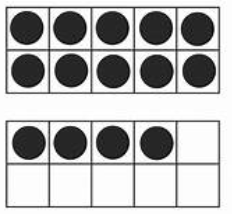
I was asked to come in and work with small groups (4-5 students) in Kindergarten today using ten-frames. The teacher wanted students to unitize by 5, 10, and 15, counting on the rest by ones. For example, if I asked a student, “How many do you see? How do you see them?”, she wanted the students to understand that you could find the value in a variety of ways. Here are a few of the anticipated answers she wants them to give by the end of the year:14

  • I counted them all. One, two, …twelve, thirteen, fourteen (Level 1)
  • I saw two- 5’s, so 5, 10, 11, 12, 13, 14 (Level 2)
  • I saw a ten, so 10, 11, 12, 13, 14 (Level 2)
  • I saw 5’s and 1 missing. 5, 10, 15, (counting backwards) 14 (Level 3)

I had a deck of ten- and double ten-frame cards, so I decided to do some “quick shows”.  I would show a card to the kids for about 5 seconds, and they had to ‘think’ about their value (versus just shouting out the number). We rotated who gave the value first, but every child had to give the value they thought was on the card. I chose a different student to explain how they got the value, then gave every other student a chance to share their thinking. We did this for about 15 minutes per group of 4-5 students.

Here are our ah-ha’s:

  • Out of the 4 groups, only one group stayed within the single 10-frame. I was getting answers from this group that were bigger than 10 every time. For example, when I showed them a card with 8 dots, one said 8, one said 12, and the other two were still counting by ones. I quickly drew a double (or triple) 10-frame and grabbed some counters (plastic circle thingies) and would show them their answer, then the original card. That worked for all but one student. For him, I kept on the table the card with the ten-frame filled in, then did the quick show. That clicked for today, but I need to do some hands-on work with this group. I also need to go back to a 5-frame and really focus on 5+ values before moving beyond 10.
  • Students needed to be convinced that the two cards below each showed a value of 5. Great for starting the discussion about the commutative property! We rotated the card over and over until someone said, “It is just the same thing! You didn’t put more on or take any off. Geez!”

5 different ways

  • The sequencing of the quick show was instrumental in students building strategies beyond counting one-by-one. The order that seemed to work the best today was as follows: 3, 5, 5 (again, upside down), 4 (to see it was 1 less than 5), 6, 8, 10, 9, 11. Notice we kept them seeing 1 more/less so they could use that strategy as well.
  • For the groups that could “just see” the ten-frame, I worked up to 20. Here is the orde18r we used with those groups: 3, 5, 5 (upside down), 8, 10, 12, 15, 14, 20, 18. 18 was tough (see the number of dots), as students really needed to push to 5’s versus  counting 10 then by ones.
  • One group finished about 5 minutes early, so we played war. That way, they each had a different card and had to tell me their value before determining who had the most dots. This was interesting, as they had the cards to touch and many reverted back to one-to-one counting. We will need to think about that for next time.

What I loved about this activity was that I had 15 solid minutes to informally assess each child. I heard what they understood and where they struggled. I was able to note for the teacher which cards each child got quickly, and which he/she reverted back to counting by ones (or guessed). Every child was engaged and had to listen to their friends as each shared out their strategy. And most important to me, every child left my group smiling, asking when I was coming back to do more “quick thinking”.

For large ten-frame cards: https://lrt.ednet.ns.ca/PD/BLM/pdf_files/five_and_ten_frames/ten_frames_large_with_dots.pdf

For double ten-frame cards: We made them by cutting/pasting two ten-frames together. I am sure you can buy the cards, but this was cheapest for us.

Quick Shows With Ten-Frames

Cross-Out: Sums to 12

Chris asked for a new game yesterday, and I didn’t have one ready (Gasp!) So we made one up together called “cross-out”. This was quick, easy to organize, and he had fun playing it and ‘cheating’.

Materials: white board, dry-erase marker, two dice (we used dot dice, but you can use number cubes to up the level of thinking)

Objective: We played as a team. The goal is to cross-out every sum when rolling two dice (2-12).

How to Play

  1. Have your child write the numbers 2-12 on the white board. This is great fine-motor practice! cross out 9
  2. Player 1 rolls the dice and adds up the values. Player 2 crosses out the sum on the board. I rolled a 9, so Chris had to find the 9 and cross it out (see below).cross out 9
  3. Player 2 rolls the dice and adds up the values. Player 1 crosses out the sum on the board. If a sum is already crossed out, continue rolling (and therefore practicing addition and counting on) until you get a sum that you can cross out. No losing turns here!
  4. Once your team has crossed-out every sum, you won! Do a silly dance to celebrate your success!

Fun Note:
When we only had the 3 to cross-out, Chris asked if we could change dice to be 0-5 instead of 1-6. “Why?” I asked. “So that I have a better chance of rolling a 3! The only way I can get it is with a 1 and a 2 and that’s tough!” If I had the 0-5 dice at my fingertips, I would have totally given in. This is a great statistics insight for such a tiny human!

He rolled a few more times, got sick of rolling and decided to just roll one die. BAM! First roll he got a 3. He was very proud of his ‘cheating’ scheme!3

Differentiation Ideas:

  • Use a number cube and a dot die to work on counting on (Level 2).
  • Use two number cubes to work on addition rather than one-to-one counting with dots.
  • Use cubes that have larger values and work on the teens/twenties. I buy square wooden cubes at a hobby/craft shop and use a Sharpie to make whatever dice I want to use. Easy and cheap!
  • Play against each other. Each person could write 2-12 and see who can cross-out their board first.
Cross-Out: Sums to 12

Tiny Human Perspectives: What About 0?

What is up with 0? It is nothing, nada, zilch. So why spend time thinking about nothing?

While playing a game with dice (labeled 0-5 each), pre-schoolers had no trouble thinking about zero as nothing.

Student (rolls a 0 and 5): 0 and 5 is still 5!

Me: Why is it 5?

Student (now rolling eyes): Because you added nothing to 5, so it stays 5. You didn’t do anything to it! (Duh…Mrs. M!)

Playing the same game in Kindergarten. Out of 20 students, only 2 (one being my son, since he already struggled with it at home and had made some headway with clarifying what happens when you add 0) students were okay not changing the value of the addend when added to 0. The others added at least one more to their addend, or just sat there and said they lost a turn because they got a 0. ????

Why the struggle?

Students use their instincts when learning. While playing (without formal teaching), the preschoolers made sense of the zero. When you add nothing to a number, it stays the same (AKA Additive Identity Property). However, this ‘sense-making’ was left behind once (I will use my son as the example) Chris started learning addition. He figured out that when you add numbers, the value changes. Every problem he did resulted in a larger value than the two addends. Mama, it gets bigger as you add. When he rolled a 0, he couldn’t make sense of that with his understanding of what addition IS. We had to roll LOTS of 0’s before he finally clicked that adding nothing doesn’t change the other addend.

What Can You Do?

Allow you child to play with a die that has a 0. Allow them to make sense of this new phenomena and open their eyes to new learnings about addition. This will help them later, when adding different kinds of numbers (like negatives) results in smaller sums.

Remember, Zero really is a Hero!

Tiny Human Perspectives: What About 0?

Race to the Top: Kinder Observations

Last week I posted a game called “Race to the Top”. I was able to play the game with all of the students in my son’s kindergarten class. I was one of the stations during center time, and had between 4-6 students each rotation. We kept them 15 min per station, which seemed enough time for their engagement. (One group ran at 20 min and it was too long.) Each person at my station had their game card (see links below for options) and each pair had one number cube (labeled either 0-5, 1-6, or 5-10) and one dot die (1-6 dots).

Here are a few observations and patterns of misunderstandings.

  1. Counting different representations is tough! The students were used to having to ‘add’ (i.e. count one-by-one) two dot dice, but hadn’t yet used a number cube WITH a dot die. When we started to play, at least one in each group said their sum was 2, no matter what was on the dice. This is because there were 2 dice. It only took a few rolls for all of them to get the hang of it.
  2. For this time of year, the 0-5 number cube was too easy (with the exception of 1 pair of students). I would use the 6-10, as most of our misconceptions surfaced once they passed the number 10. Here are the misconceptions after 10.

Example: 9 + 5 dots

  • Misconception 1 (counted backwards from their number):  “9…8, 7, 6, 5, 4.”
  • Misconception 2 (started counting by 10’s):  “9…10, 20, 30, 40.”
  • Misconception 3 (counted them separately and got stuck): “9 and 5…pause…”
  • Misconception 4 (wanted to put 14 squares on the game board, not see it as one-14)

After about 2 minutes of playing with me direct instructing, the students were successfully independent, taking turns and excited to see what their value was. In 15 minutes, I was able to watch, assess, and intervene every child in my group several times. They were engaged and excited to be playing. We averaged 18 sums per player in the 15 min, which is a LOT of addition!

Favorite Quotes of the Day

  • You cheated! You can’t keep rolling until you get your number! (This would have been me as a child!)
  • Wait. We can’t play anymore? Awe.
  • I only need two more 12’s to win! You need two more 7’s! It’s a tie! (I get giddy when students do more math than asked!)
  • Thanks for playing games with us, Chris’ Mom!

Game Board for 0-10 (Change as needed depending on the number choices for your dice)

Race to the Top Game Board


Race to the Top: Kinder Observations

5 Easy Daily Math Ideas

I was walking Chris (5 yo) to school yesterday (as we do most days) and was stopped by his Principal. He commented, “You always are counting when you come to school. I wish more parents would do that with their kids.” So it got me thinking; what are some easy-peasy ways parents can support their kiddos with math in the early years? Here are 5 ideas that you could start TODAY! Choose 1 or 2, and use them every day for a few weeks to really see their number sense and mad math skills bloom! Please comment with other ideas as well so we can have a huge vat of fantastic learning opportunities to use with our babes!!!

  1. Counting, Counting, Counting! We do count on the way to school. EVERY. SINGLE. DAY. At first, it was to 20, then to 50, and now we are up to 150! We count by 1’s most days, but sometimes we go rogue and count by 10’s (gasp!). Just like singing the alphabet, rote counting is a must to learn numbers. Start with 1’s, then 10’s for Kinders and younger. Move to 2’s, 5’s, 3’s, etc… and you have provided a solid foundation for initial multiplication! Move to counting by 1/2’s, 1/4’s, 1/3’s (you get the idea) and you are rocking initial fractions! Start with a different value that 1 and you are moving mountains!
  2. Counting Forwards AND Backwards: Stairs are great for this. Count up when you go up stairs, down when you go down. Don’t know how many stairs? Start at 20 and count down. If you don’t hit 0, oh well!
  3. I have...: In the produce section of the grocery store, you need 6 potatoes. Ask you tiny human, “I have 2. How many more do I need to have 6?” This is AMAZINGNESS! I cannot tell you how many teachers have students who struggle with missing addend problems. This will help so much!!! Do it at home with the silverware. “We need 4 plates. I have 1. How many more do I need?” The opportunities are endless for this!
  4. Sort! Sort! Sort! Kids can sort the silverware that comes out of the dishwasher (Take out sharp objects first, please!), socks, toys, coins (when you are at a restaurant or doctor’s office), mail, school work, books, buttons, etc. Sorting is super important, as it builds the idea of structure and patterns as well as organizing and classifying information.
  5. Guess my Number: A car-time fav in our family. “I am thinking of a number. It is bigger than 5 and smaller than 10. What is my number?” And you can amp this up for older students as well. Use multiples, even/odd, negative values, fractions, square roots, etc. And once they get the hang of it, each person in the car gets a turn to be the number-chooser. Super easy, and builds magnitude of numbers, place value, and relational thinking.
5 Easy Daily Math Ideas

Race To The Top! Counting On

So my tiny human, Chris, loves to add, but always has to start from one (no matter what the values are). I finally figured out a game to play to push into Level 2: Counting On (see previous blog for more info on the levels of single digit addition/subtraction).

Objective: To get to the top of one of the columns (doesn’t matter which one) first!

Materials: 2- Race to the Top Game Boards (click on link) Race to the Top Game Board 2-dice:  Since Chris is working on making sums to 10, I created my dice. You do not have to, but it is super easy and cheap! Go to a hobby store or home improvement store and buy wooden cubes. On the first one, label with the numbers 0-5. On the second one, draw dots on it (like a normal die), but use 0-5. Notice my mad dot-drawing skills! img_8144.jpg

How to Play: First player rolls the dice. He ‘traps’ the number (in the case above, the 3) and counts on one-by-one if need-be the dots. He puts an object above the sum’s number on the game board. Please view the example. Note the time it takes for Chris to figure it out, but he still gets it. This is tough when children are used to adding with objects and we replace one set of objects with a number!

Notice how he is also doing some mental work with figuring out “how many more” he needs to win the game.

IMG_8148Player 2: Roll dice, count on, and place the object on her game board. Continue until someone reaches the top of a column.
Look at how many addition problems he had to complete to finish the game! He never even noticed all the fantastic work he did! (Insert evil laugh.)


For Differentiation

Level 1 (Counting All): Use dot dice for both instead of one dot and one number cube. That way he is working on his one-to-one counting and adding all together! You can also make a 0-6 page and use 0, 1, 1, 2, 2, 3 dots for each cube.

Level 3: Use both number cubes instead of dots. You could also use number cubes 1-6 and create a game board from 2-12.


Race To The Top! Counting On

Levels For Single-Digit Addition: Where Is Your Child?

‘Tis the season in Kindergarten for learning addition and subtraction. You may wonder where your child is with respect to these foundational operations. Most educators will think about their students’ learning of single digit addition/subtraction as a 3-level progression. I will focus on addition for sake of space.

Level 1: Counting All

This is where most kinders should be. They can even end the year in this level and be awesome! At Counting All, students typically use concrete objects to count one-by-one in order to find the sum. Below is an example, using 2 + 3.

Level 2: Counting On

This is the “trap and keep” idea. The first addend is “trapped” in your mind, and you count on from that value. This is a more sophisticated idea, because you have to understand that the first addend is a quantity of its own, and you are moving forwards from that value (versus starting at 1 every time). Often your child will “trap and keep” the first addend by taking their hand to their head to “trap” it in their mind, then use their fingers to count on. So for 5 + 3, they would “trap the 5” and count on, “siiix….sevennnnn…eighhhht”. This is a level many children live in for quite some time.

Level 3: “Messing with Math!”

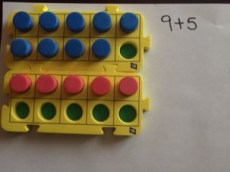
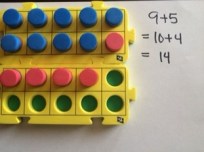
That is actually NOT what it’s called, but I like this title much more! This is when children start realizing that there are certain “cheats” that they can use to do more of the math in their head. (Mathematically, they are called properties, but that is for another blog!) I will actually devote an entire set of blogs for this Level, as it is that important. But for now, here is an example using ten-frames with the expression, 9 + 5.9+5

9+5cStudents can see that, if they take one of the five (reds) and move it up with the nine (blues), they can make a 10. 9+5 can be renamed as 10+4=14. This is HUGE for students in terms of flexibility with numbers and algebraic thinking!
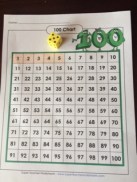
Children will ebb and flow between these three levels. The important thing is to play, explore, and play some more! The next few blogs will encourage this through games that I am trying out with my son’s Kinder class!!!


For more information, please visit: https://www.cde.ca.gov/ci/ma/cf/documents/mathfw-appendixc.pdf (This is one of the best versions…Go CA Framework Committee!)

For the ten-frames (I love these because they are soft and quiet!): https://www.schoolspecialty.com/magnetic-board-set-1400695


Levels For Single-Digit Addition: Where Is Your Child?

Rolling to 100

I had the pleasure of volunteering in my son’s Kinder class for 100 day. She had a great ‘filler’ game that I wanted to adapt and share. This is a great one to take to a restaurant where they hand out crayons!

Materials: 100 chart, one per player (see below for link), die (dot for one-to-one correspondence, numbered for numeral recognition with counting), crayons (at least 2)

Objective: To be the first person to color in all 100 numbers!

How to Play

  • Player 1 rolls the die and colors in that many spaces, starting at 1. Player 2 does the same on his/her gameboard. (Example: rolling a 5)rolling 5
  • Player 1 rolls again and, in a different color, colors in that amount. So if I rolled a 2, I would color in the next two squares in a different color. Continue playing until someone reaches 100.

How I would change it

  1. Give your child a blank 100 grid and have him/her fill it in for writing practice. Then use their board to play.
  2. Change out the dice as your child grows in his/her number sense. Using larger numbers will create patterns and encourage counting by larger groups instead of by ones.
  3.  We are going to play to 20 and write the addition sentences on a whiteboard.         So 5 + 2=7 for the last play.  Also you could relate to counting on. Start at ______ move forward ______. I am now at _______. Starting at numbers other than 1 or 0 to chris 100count is a BIG DEAL!
  4. We are going to start at 100 (or 20) and go backwards to roll to 0! Counting backwards is just as important as counting forwards!
  5. Find the values. After Chris finishes up his very crumply 100 chart, he is going to guess my number. Example: My number is blue and is bigger than 23 but less than 26. Guess my number!
Rolling to 100

Playing with Math: The Function Machine

I love this game, because you can tailor it to the level of your child. Any child, preK through adult, can play and find it challenging and fun!

The Function Machine

Grade Levels: Any, depending on how complex you make the function.

Materials: paper and pencil (whiteboards or Magna Doodles are great, too!  We just used the Magna Doodle in the car on a 3-hour drive and it worked great!!)

  1. Draw a function machine. It need not be fancy, but if you google image function machines you will get tons of ideas. function machie twoMine (as I am on the lazy side) typically look like a rectangle with an opening at the top (for the input) and an opening at the bottom (for the output). They are just very boring and sad. The one to the right is super cute and soooo not me.
  2. Choose a rule (function) to use. So my rule for my PreK could be “one more” or “+1”.
  3. Your child gives an input number. You give the output number. Example: My son loves the number 5 (after all, he IS 5).  So he would put in the number 5 and I would tell him the output is 6. [It is better if you make cool sounds as if the function machine is DOING something. This is supposed to be FUN, remember???]
  4. Your child keeps guessing numbers, as you fill in the outputs each time, until they realize the pattern and can express it either in words or as a ‘math rule’ (expression). If they guess the rule wrong, keep playing until they get the correct rule.
  5. This is really fun when you have more than one kiddo playing. However, they may only guess when it is their turn. That way, everyone has a chance to play and learn.

Let’s Try One! 

  1. You enter 5 into the function machine. beep boop beep boop! Out comes 7.
  2. You enter 2 into the function maching. beep boop beep boop! Out comes 4. (Got a guess for what the function rule is????)
  3. You enter 10 into the function machine. beep boop beep boop! Out come 12.
  4. You say the rule is “plus two each time”. Yup! The rule is the machine adds two to each input (or y=x+2 for your middle schoolers).

Suggestions for Different Grade Levels:

Grades K-2: add 1, add 2, add 5, add 10, add 100, subtract 1, subtract 2, subtract 10, subtract 20, etc

Grades 3-5: same as above (Fluency in arithmetic is important!) and multiply by 2, multiply by 5, multiply by 10, take half, divide by 10

Grades 6-up: combine operations multiply by 2 and add 1 (2x+1), triple a number minus 1 (3x-1),  a number times itself (square it), take half of a number and add 1 (1/2x+ 1), etc. You can also include negative rules as well (like multiply by -3).

You can also create a function table and just fill in as input/outputs as well, if they are above having a cute function machine. I have inserted one below as an example. function table

These are so great for trips and such, because all it takes is a napkin and a pen (and your rule). Finding relationships is imperative for algebra. This is a great way for kids to play with the ideas they need for later mathematics!


Playing with Math: The Function Machine