Today was our first day of Distance Learning from our school. Though I am grateful for all of the lessons now being planned out and having some awesome challenges to engage in (Shout Out to Coach SMITH and Mrs. NEAL!!!!), it messed up the routine we had been rolling with. I spent so much time navigating the different sites and trouble shooting that I didn’t have time to prep the new colored strips I needed to start thirds, sixths and ninths for the Fraction Kit.
I honestly thought Chris wouldn’t ask about the math, as he had so much to do for his other classes. (I was ready to ditch out on the fractions today.) But he asked at lunch, When are we having our fraction time, Mom? How can you say no to that?!!! (Well, okay lots of us can, but anyone who knows me knows I can’t. Ask my good friend who had to wait for me to write on receipt paper math tutorial links for the cashier at Total Wine the other day!)
Fortunately, a good friend had posted on Facebook a recipe for making salt-dough ornaments. See below for the recipe, but what I loved about it was there are only 3 ingredients (And I had them all!!!!) and the amounts were cups and halves. Perfect!
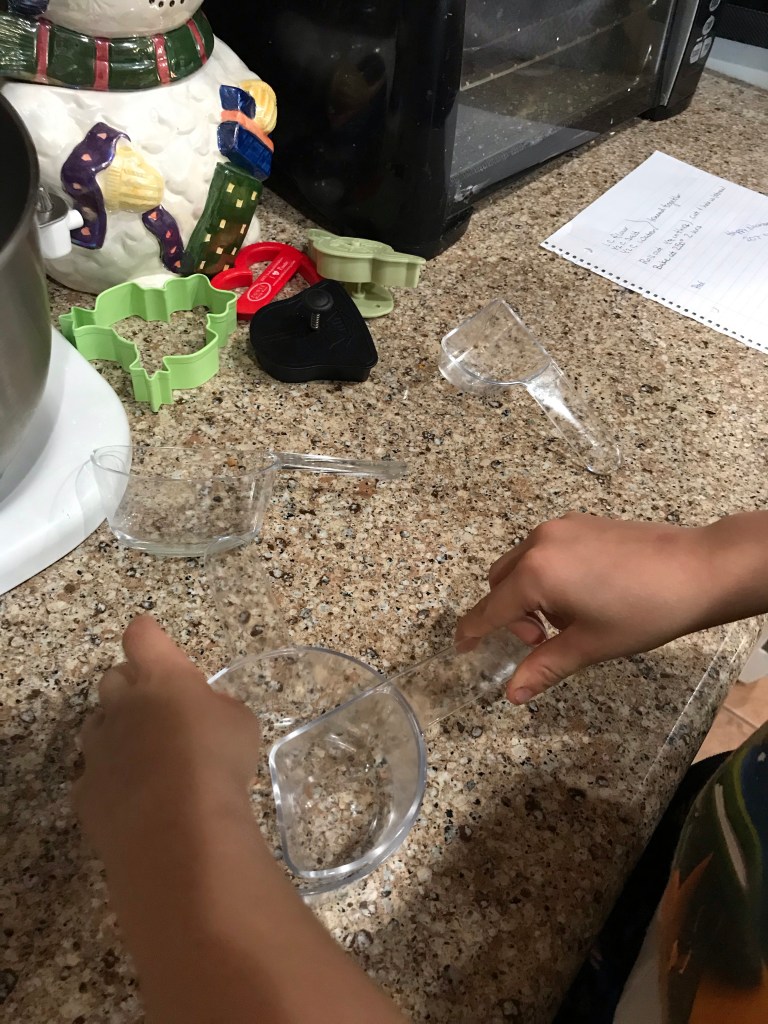
- I pulled out all of my measuring cups and asked Chris how he would name them. He called the full circle 1 whole. He took the others and rotated them within the cup to figure out how many fit inside. Pretty similar to the Fraction Kit, but with circles. We named them verbally and I asked him to find the fourth. We put the rest away.
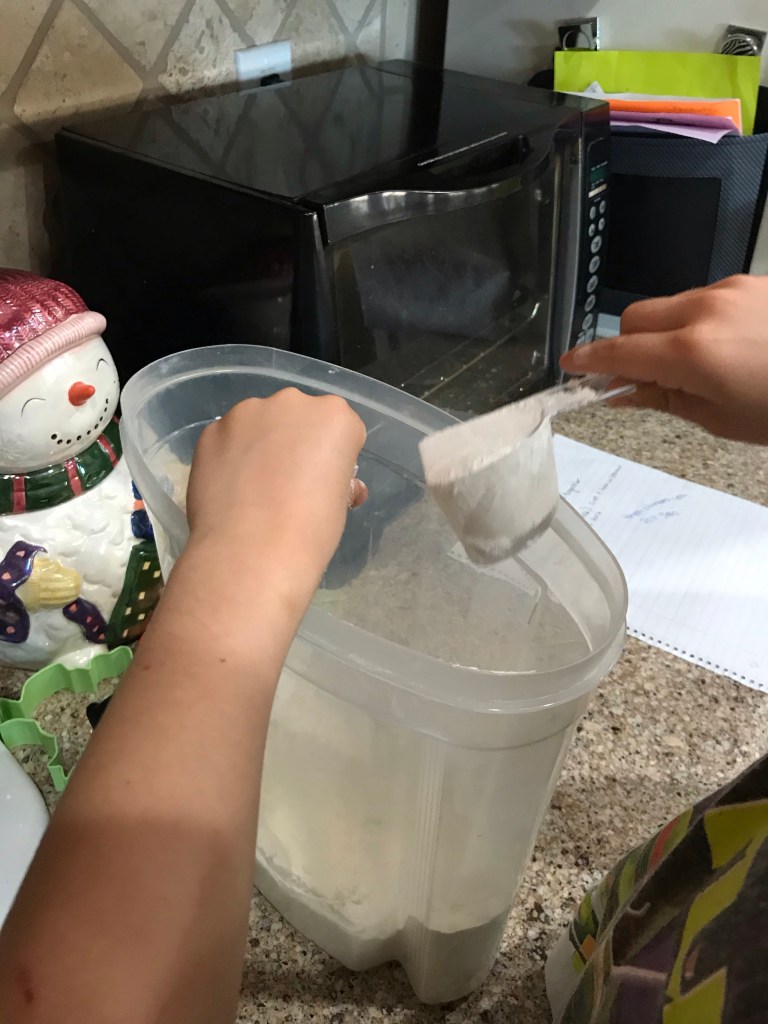
- I asked him to measure 1 cup of flour with the 1/4. How many fourths would you need to make a whole cup? 4 How do you know? Because it takes four of them to make a fourth. (He rotated the 1/4 in the air to show the whole circle.) 1-fourth, 2-fourths, 3-fourths, one-whole.
- We needed to measure 1/2 cup of salt. How can you use the 1-fourth to find 1-half? Well, since 4 of them made a whole, I need only 2.
- We needed to measure 1/2 cup of water. I didn’t bother asking; I knew he got the gist of it.
The recipe is super easy to make and fun to create different ornaments to paint and share with friends during this isolation time. I am having Chris write a letter with each to send out next week so we can get some Pen-Pal action going!
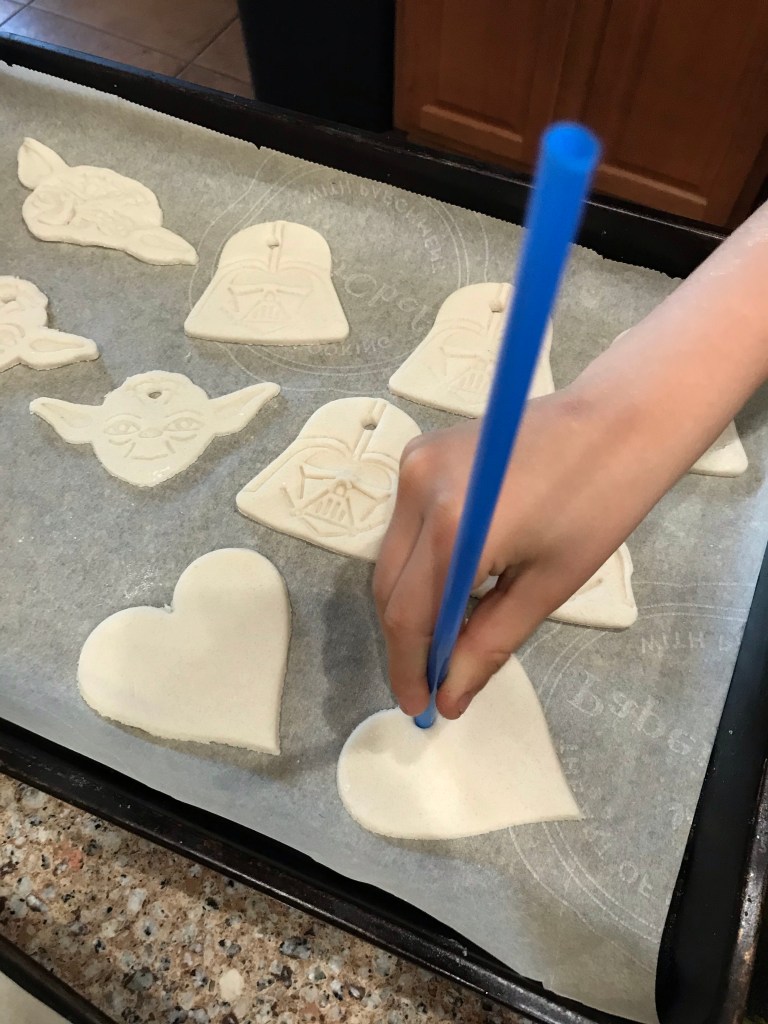
Note: We did not put parchment paper down the first time we rolled out the dough and it was a huge mistake! Place parchment or wax paper down and sprinkle some flour before rolling out the dough.
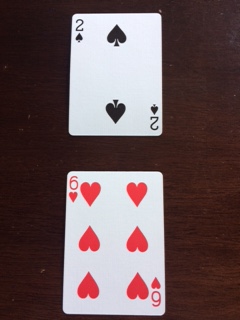
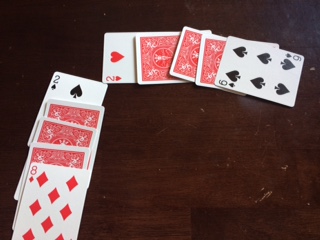
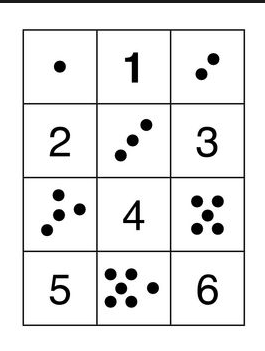 goes faster and they are working only with 2, 3, 4, and 5. You can use the aces as 1. Even better, use number cards or dot cards (see below for links). Print on cardstock (4 cards per number) or go online and buy a set.
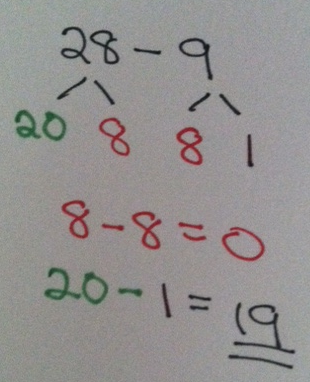
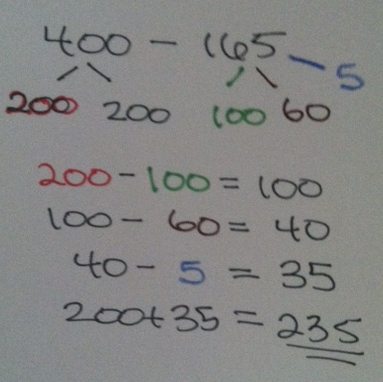
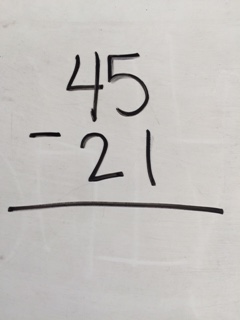 Here I only see single digit subtracted by single digit. I do not see 40 – 20, but 4 – 2 and 5 – 1. This is okay for problems where we do not have regrouping. However, some students get so stuck in the process of regrouping that they no longer see the value of the places and just write a very ‘random’ value as the difference. When I write the problem horizontally (45-21), it allows me to view it from a place value perspective. My eyes look first at the tens and then the ones, versus the horizontal example where I start with the ones and then look at the tens. Also, writing it horizontally does not constrict me to a “stack and subtract” method. (See prior blog for more info on great subtraction strategies to help kiddos.) Really, both are fine; no need to get all uppity about it. And if a teacher says they HAVE to write it that way, it is not true, but what is true is that they learn to think about relationships and different strategies using place value and properties of numbers BEFORE learning the standard algorithm. In fact, the standard algorithm for multi-digit subtraction should not be mastered until grade 3:
 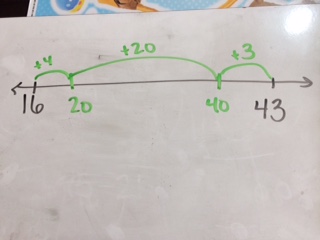 Notice this is a great strategy for students who struggle with regrouping, because there IS NO REGROUPING!!! I went up 4 to the nearest ten (20), added 20 more (40), and ‘hopped’ 3 more to get to my end point (43). 4 + 20 + 3 is 27. Therefore, 43 -16 = 27. Using the tutor’s problem (43-13), I think adding up is efficient, if you move up by tens. I can simply add by tens
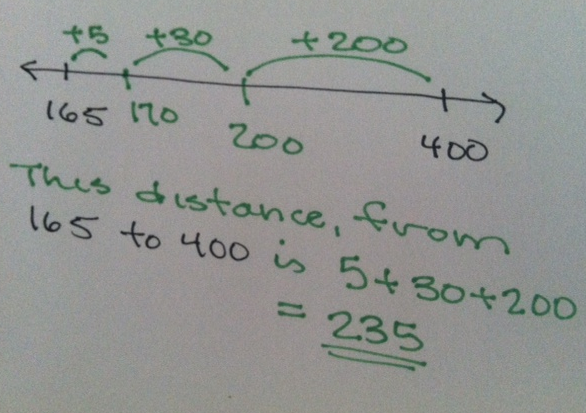
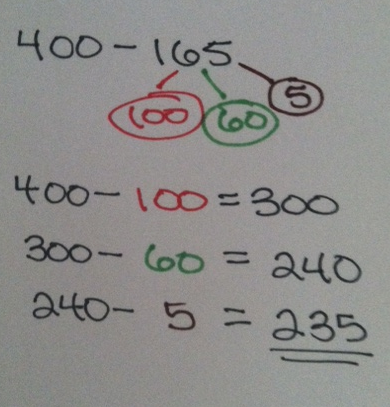
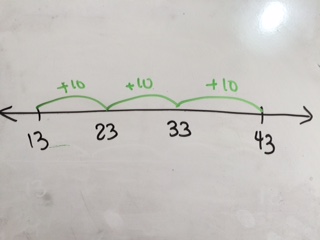 until I reach 43. 3-tens is 30. Not sure why it is so convoluted in her explanation and NO! Students do not have to add up the same way the tutor did. In fact, that is the wonderful thing about Common Core.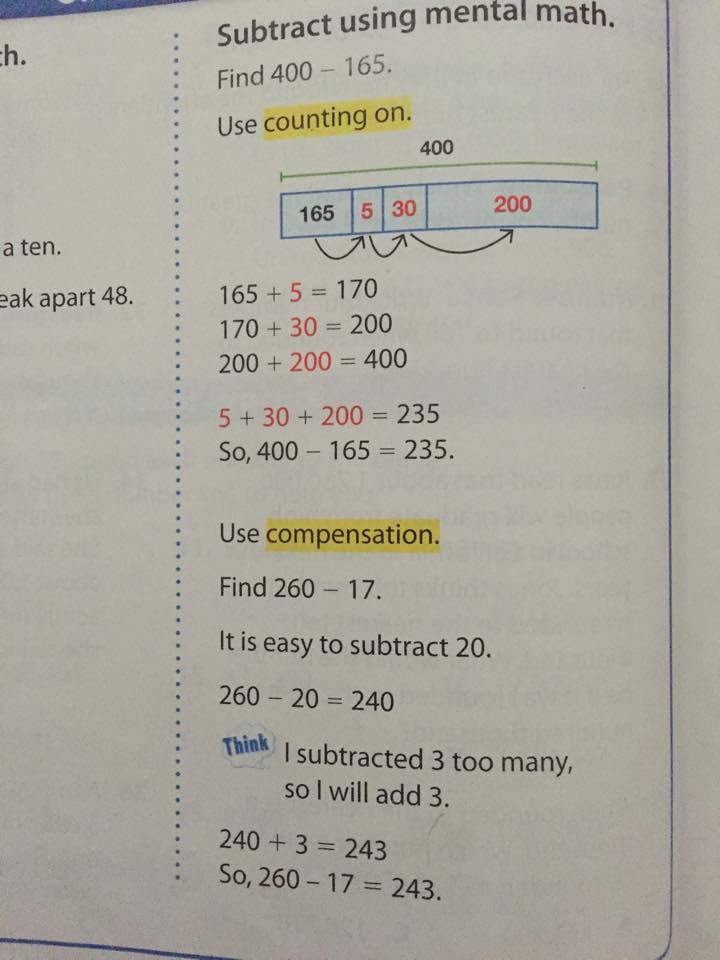


 moffett4understandingmath