With my family on the go so much during the non-lazy days of summer, we need easy games to entertain the tiny humans that don’t require mass amounts of attention from the adults (who are often in conversation). Enter the game of War. This versatile game can be used for all age groups and can really keep your child’s skills in arithmetic in check during the “summer slump”.
How to Play (Basic Version)
- Grab a deck of cards (I keep one in my purse and in the car at all times). You don’t have to, but I prefer to take out the face cards and jokers. Shuffle the rest and divvy out to all who are playing.
- All players shove all of their cards into a “deck” and keeps the deck face down.
- All players (at the same time to avoid cheating) flip the first card. The player with the largest value is the winner and takes all of the cards in the round.

- If there is a tie (that is the largest value), those players place 3 cards on their original face down and flip the fourth card. Whichever player NOW has the largest value gets all of the cards from the round.
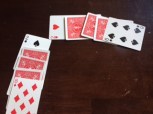
- Continue playing until either a) one player has all of the cards; or b) you get sick of playing. The player with the most cards is the winner.
Additional Versions
- For younger players: Use only 2-5 from the decks and play with those. The game
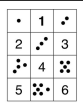 goes faster and they are working only with 2, 3, 4, and 5. You can use the aces as 1. Even better, use number cards or dot cards (see below for links). Print on cardstock (4 cards per number) or go online and buy a set.
 - For any age: You can also play and whoever gets the smallest value wins. This is great for preK-1st graders!
- For students who need review with addition: Play two cards at a time and add them. The player with the largest sum is the winner of the round.
- For students who need review with multiplication: Play two cards at a time and multiply them. The player with the largest product is the winner of the round.
- For grades 5-7: red cards are negative values; black cards are positive values. Flip over one card. If I have a red 6 and you have a black 2, you are the winner since positive values are always greater than negatives.
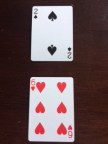
- For grades 6-8 (or 7-8 if using Common Core): Play two cards and add them, using reds as negatives and blacks as positives. The player with the largest sum is the winner of the round.
- For grades 6-8 (or 7-8 if using Common Core): Play two cards and multiply them, using reds as negatives and blacks as positives. The player with the largest product is the winner of the round.
- For grades 6-8, use only values ace (for 1) through 5. Flip the first card; that is your base. Flip the second card; that is your exponent. The player with the highest value wins the round.
Different Sets of Cards:
- You could probably look on Amazon for different card types, but I love the sets at 52 Pickup. They are of high quality and there are many different types ranging from dot cards to ten frames to cards that go through the thousands (so you can work on place value!)
https://sumboxes.com/collections/types?q=52%20Pickup%20Card%20Decks


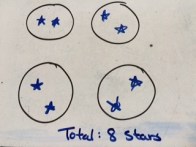
 I don’t get it. Can you help me? My teacher didn’t explain it. I forgot. This is stupid.


 Geogebra:
 Math Learning Center:



 Note: The pic of L is her final message to me before I left. Her normal is not our normal; her normal is way more fun (as math should be!).
  Here I only see single digit subtracted by single digit. I do not see 40 – 20, but 4 – 2 and 5 – 1. This is okay for problems where we do not have regrouping. However, some students get so stuck in the process of regrouping that they no longer see the value of the places and just write a very ‘random’ value as the difference. When I write the problem horizontally (45-21), it allows me to view it from a place value perspective. My eyes look first at the tens and then the ones, versus the horizontal example where I start with the ones and then look at the tens. Also, writing it horizontally does not constrict me to a “stack and subtract” method. (See prior blog for more info on great subtraction strategies to help kiddos.) Really, both are fine; no need to get all uppity about it. And if a teacher says they HAVE to write it that way, it is not true, but what is true is that they learn to think about relationships and different strategies using place value and properties of numbers BEFORE learning the standard algorithm. In fact, the standard algorithm for multi-digit subtraction should not be mastered until grade 3:
  Notice this is a great strategy for students who struggle with regrouping, because there IS NO REGROUPING!!! I went up 4 to the nearest ten (20), added 20 more (40), and ‘hopped’ 3 more to get to my end point (43). 4 + 20 + 3 is 27. Therefore, 43 -16 = 27. Using the tutor’s problem (43-13), I think adding up is efficient, if you move up by tens. I can simply add by tens
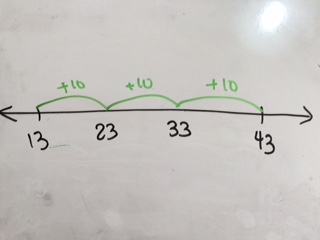 until I reach 43. 3-tens is 30. Not sure why it is so convoluted in her explanation and NO! Students do not have to add up the same way the tutor did. In fact, that is the wonderful thing about Common Core.
  moffett4understandingmath