Playing with Math: The Function Machine

I love this game, because you can tailor it to the level of your child. Any child, preK through adult, can play and find it challenging and fun!

The Function Machine

Grade Levels: Any, depending on how complex you make the function.

Materials: paper and pencil (whiteboards or Magna Doodles are great, too!  We just used the Magna Doodle in the car on a 3-hour drive and it worked great!!)

  1. Draw a function machine. It need not be fancy, but if you google image function machines you will get tons of ideas. function machie twoMine (as I am on the lazy side) typically look like a rectangle with an opening at the top (for the input) and an opening at the bottom (for the output). They are just very boring and sad. The one to the right is super cute and soooo not me.
  2. Choose a rule (function) to use. So my rule for my PreK could be “one more” or “+1”.
  3. Your child gives an input number. You give the output number. Example: My son loves the number 5 (after all, he IS 5).  So he would put in the number 5 and I would tell him the output is 6. [It is better if you make cool sounds as if the function machine is DOING something. This is supposed to be FUN, remember???]
  4. Your child keeps guessing numbers, as you fill in the outputs each time, until they realize the pattern and can express it either in words or as a ‘math rule’ (expression). If they guess the rule wrong, keep playing until they get the correct rule.
  5. This is really fun when you have more than one kiddo playing. However, they may only guess when it is their turn. That way, everyone has a chance to play and learn.

Let’s Try One! 

  1. You enter 5 into the function machine. beep boop beep boop! Out comes 7.
  2. You enter 2 into the function maching. beep boop beep boop! Out comes 4. (Got a guess for what the function rule is????)
  3. You enter 10 into the function machine. beep boop beep boop! Out come 12.
  4. You say the rule is “plus two each time”. Yup! The rule is the machine adds two to each input (or y=x+2 for your middle schoolers).

Suggestions for Different Grade Levels:

Grades K-2: add 1, add 2, add 5, add 10, add 100, subtract 1, subtract 2, subtract 10, subtract 20, etc

Grades 3-5: same as above (Fluency in arithmetic is important!) and multiply by 2, multiply by 5, multiply by 10, take half, divide by 10

Grades 6-up: combine operations multiply by 2 and add 1 (2x+1), triple a number minus 1 (3x-1),  a number times itself (square it), take half of a number and add 1 (1/2x+ 1), etc. You can also include negative rules as well (like multiply by -3).

You can also create a function table and just fill in as input/outputs as well, if they are above having a cute function machine. I have inserted one below as an example. function table

These are so great for trips and such, because all it takes is a napkin and a pen (and your rule). Finding relationships is imperative for algebra. This is a great way for kids to play with the ideas they need for later mathematics!


Playing with Math: The Function Machine

War!(HUH!) What is it good for? (Absolutely lots in Math!)

With my family on the go so much during the non-lazy days of summer, we need easy games to entertain the tiny humans that don’t require mass amounts of attention from the adults (who are often in conversation). Enter the game of War. This versatile game can be used for all age groups and can really keep your child’s skills in arithmetic in check during the “summer slump”.

How to Play (Basic Version)

  1. Grab a deck of cards (I keep one in my purse and in the car at all times). You don’t have to, but I prefer to take out the face cards and jokers. Shuffle the rest and divvy out to all who are playing.
  2. All players shove all of their cards into a “deck” and keeps the deck face down.
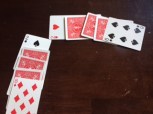
  3. All players (at the same time to avoid cheating) flip the first card. The player with the largest value is the winner and takes all of the cards in the round.IMG_5434
  4. If there is a tie (that is the largest value), those players place 3 cards on their original face down and flip the fourth card. Whichever player NOW has the largest value gets all of the cards from the round. IMG_5435
  5. Continue playing until either a) one player has all of the cards; or b) you get sick of playing. The player with the most cards is the winner.

Additional Versions

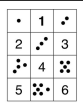
  • For younger players: Use only 2-5 from the decks and play with those. The game dot cardsgoes faster and they are working only with 2, 3, 4, and 5. You can use the aces as 1. Even better, use number cards or dot cards (see below for links). Print on cardstock (4 cards per number) or go online and buy a set.
  • For any age: You can also play and whoever gets the smallest value wins. This is great for preK-1st graders!
  • For students who need review with addition: Play two cards at a time and add them. The player with the largest sum is the winner of the round.
  • For students who need review with multiplication: Play two cards at a time and multiply them. The player with the largest product is the winner of the round.
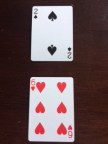
  • For grades 5-7: red cards are negative values; black cards are positive values. Flip over one card. If I have a red 6 and you have a black 2, you are the winner since positive values are always greater than negatives. IMG_5434
  • For grades 6-8 (or 7-8 if using Common Core): Play two cards and add them, using reds as negatives and blacks as positives. The player with the largest sum is the winner of the round.
  • For grades 6-8 (or 7-8 if using Common Core): Play two cards and multiply them, using reds as negatives and blacks as positives. The player with the largest product is the winner of the round.
  • For grades 6-8, use only values ace (for 1) through 5. Flip the first card; that is your base. Flip the second card; that is your exponent. The player with the highest value wins  the round.

Different Sets of Cards:

  • You could probably look on Amazon for different card types, but I love the sets at 52 Pickup. They are of high quality and there are many different types ranging from dot cards to ten frames to cards that go through the thousands (so you can work on place value!)

https://sumboxes.com/collections/types?q=52%20Pickup%20Card%20Decks


War!(HUH!) What is it good for? (Absolutely lots in Math!)

That Moment You Realize Your Child Is Suffering

All who have multiple children know that each one is wonderfully different. You can raise ’em the same, yet they have their own amazing quirks and personalities, strengths and passions. This could not be more true of my two boys.

My youngest is now 5. He has always been the rough and tumble type. Everything is a competition to him. (Even last night he was standing on his tippy toes trying to be ‘taller’ when raising his hand at church!) He is funny, outgoing, and a firecracker. He is a joy.

Yet school stuff has not yet become his thing. He seemed disinterested in learning his letters, yet loved to be read to. He never wanted to sit with me and learn the components all say are so important for kinder. His preschool teachers said it would come; that he just was a busy bee and had other, more important things to care about. And honestly, I believed that too. He loves to create, tell stories, sing, build, and live outdoors. Who was I to take that away from him?

So when his amazing preK teacher suggested a hearing test, I was on board. No big deal; just go do it and cross it off as another thing we did. It came back inconclusive. Went for an ENT hearing test. The results were staggering; at least 30% hearing loss in each ear. The doctor said, “Think of being submerged underwater for 5 years of your life, trying desperately to hear what people are saying. That is what your son has lived through.” I am still teary thinking about this. I am a fricking educator! How did I not catch this?  I was in denial as well, until that very day driving home I asked my boy if he saw the cool tree. “Tree?” “Yes, the tree over there (I pointed out the car window.).” “Like, dessert?” And that is when it hit me. My child wasn’t hearing.

We started to notice. He said, “What?” almost every time you told him something.  He couldn’t hear the TV clearly; he was reading lips (which we now know why he would never answer us when watching TV; he was too focused on the screen to hear us). In preK, during circle time, he struggled to hear all the conversations and his body would just be exhausted from trying to listen that he gave up.  When listening to a story, he focused on the pictures for meaning versus our words. He was trying his best, his very best, and it was exhausting. My heart broke. My baby boy, sweet thing he is, was struggling under my teacher nose, and I hadn’t caught it.

Long story short, he is now hearing much more, with just a tweak of medication. He still has a hearing loss, and we will test every year to make sure it isn’t degenerative. He is learning how to deal with sounds he hadn’t heard before. (At church last night he couldn’t believe they played bells!) He begins speech therapy (I had no idea he would need that either) next week and they are excited to see his progress, as am I. And funny enough, he is now interested in learning his letters, sounds, words, etc. It all makes sense; for how can you be interested in something you never knew existed?

I bring this story up for one reason. We are not perfect. Even if we have our children’s best interests at heart, we may miss something. It takes a true village to raise our children. If you do not have a village to help, find one. If your children go to daycare or summer camp, get to know their counselors. Ask them questions. Find out what your children are doing, and how they are doing. Talk to your children’s teachers next year. Get to know them, because they see your children more often than you do! And listen, even when you don’t want to. In a world that is so negative right now, I feel strongly that we need to support, build, and nurture each other and our tiny humans in order to make them the best they can be.


That Moment You Realize Your Child Is Suffering

How Many Are Hiding?

This is a great game for tiny humans in need of some entertainment while waiting at a restaurant. Just make sure to ask for an extra children’s cup to play.

Age Level: 3-6 year olds

Materials: children’s plastic cup (any cup will do, just not transparent), a set of objects (I used goldfish for the example, as that was what was in my purse! Other options are pennies, beans, tiny annoying toys, etc.)

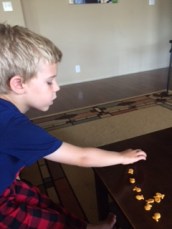
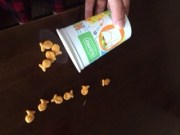
How to Play: Place out a certain number of ‘stuff’. Normally for me, it is however many I have in my purse! I would recommend starting with 5 or less, see how they do, and adjust as needed. The first time I played with my 5 year old, we started with 10 and it was quite frustrating for him. They catch on and you can up the number as they grow!

  1. Have your child count how many there are. IMG_5269
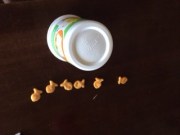
  2. Have your child close his/her eyes. Hide some of the objects under the cup.IMG_5276      IMG_5275
  3. Ask your child to open his/her eyes. Ask the following:
    1. How many do you see?
    2. If there were _________ to start with, how many are hiding?
  4. Allow your child to check their answer by lifting the cup.
  5. Ask the following:IMG_5274
    1. How many were hiding?
    2. How many were out?
    3. How many in all? (Woah! It is the same as what we started with! Weird!)
  6. Switch who hides and who plays.

Why play? Aside from counting one-by-one and ‘holding’ that number in their heads, students need lots of practice understanding that a number can represent an amount. That amount can be broken into parts (decomposed), but when we put them together (add them) they make the original number we had. This is part of the idea of conservation, which is critical for young mathematicians to understand (not the word but the idea) in order to add and subtract numbers.

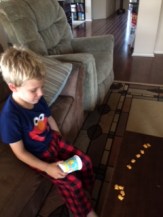
Special thanks to my tiny human for playing this morning! Love ya, bud!


How Many Are Hiding?

Playing With Math: Circles and Stars

Ahhh…summer. For many of us, that means more time with the kids…waiting. Waiting at a restaurant, doctor’s office, airport, etc. For many kids, it may also mean waiting to use their brain. Research suggests that students can lose as much as 2 months of learning skills during the summer months (Oxford, 2017).  So how can we use the waiting times (or times at home when they are claiming boredom) to retain and advance their learning in mathematics? Play games/activities.

While there are many great apps for kids, I would request less screen time and more interaction with your children.  For the next three months, I will suggest a game/activity that you can use with your child. I will suggest different levels, so that you can play it often and in different ways. I use these same games with my own children, and find the time waiting goes much quicker, with less outbursts and meltdowns. Further, I am modelling playing with math, which is truly the way I feel our children learn and understand math best.

Circles and Stars (Marilyn Burns)

Grade Levels: Though used in grade 3, if all you are doing is counting the number of stars I would recommend grades 1-5. My preK has played it and just counts one by one. He cannot make the stars, so he draws x’s.

Materials: die (number cube or dots; doesn’t matter), paper or napkin, pen or pencil (I prefer a travel size Magna Doodle or whiteboard with dry erase marker)

LEVEL 1

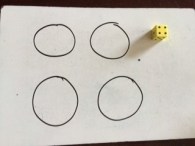
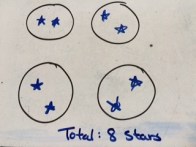
  1. Roll the die. Draw that many circles.circles
  2. Roll a second time. Draw that many stars in EACH circle. stars
  3. Total the stars. Whoever has the most stars wins the round. (Play as many rounds as you want. The winner could be the one with the most stars total. Woo hoo! More math!)
  4. Alternative: The winner is the player with the least amount of stars.

LEVEL 2

  1. Roll 2 dice (or the die twice in a row). Player chooses which die represents the number of circles and the number of stars in each circle.
  2. Total the stars. Whoever has the most (or least) stars wins the round.

Questions to ask:

  • If I was to switch which die represented the number of circles and stars, what would happen? (The picture would look different, but the total stars would stay the same. This is the beginning of understanding the commutative property for multiplication.)
  • How could we represent what we did in words? (Example: 4 groups of 3 stars is 12 total stars.)
  • How could we represent what we did as an expression?                                   (Example: 4 x 3 = 12)

Link for Summer Learning: https://www.oxfordlearning.com/summer-learning-loss-statistics/


Playing With Math: Circles and Stars

Cool Tools for Kids in Math

Happy Mother’s Day AND Teacher Appreciation! Here are my gifts to you: FREE APPS and Sites to help your children (and students) learn math!!! Read on!

These past three days I got to geek it up at the NCTM annual conference in San Francisco. I have gone to several annual conferences, but this was the first time I worked in an exhibitor booth rather than attending as a participant. I was excited to be on the other side of the conference scene, but sad that I wasn’t sitting on the carpet (like so many) scouring the magazine o’ options for the perfect sessions.

As a teacher, I would ditch the exposition hall (except to get the free Legos and swag for my boys!) and attend every session I could. I would take copious notes, trying hard not to miss anything that was said in case THAT was my take away for the trip. Those fabulous notebooks that I poured my 72 hours of the conference into gather dust in a box in the garage. Don’t get me wrong; I would typically use 3-5 ideas/worksheets/tasks/quotes per conference. But was that worth the hours I sat in the back of a crowded room? Was there more to the conference than the sessions?

YES! This year I attended a single 60 min session and got several great ideas for a district I work with. The rest of my time was spent in the exhibition hall talking to reps (and long-time friends!), discussing mathematics, and truly learning from one another in a more intimate setting. I learned so much in these conversations, AND spent time at many vendor booths playing with the technology that I believe can truly make a difference in how students view mathematics. Though I am still grappling with the lack of notes in my handy-dandy notebook, I feel I am leaving with far more applicable ideas and tools than ever before!

The links below are (free!) sites you and your child can explore to really learn mathematics. They allow students to truly see what is going on and why the math “is what it is”. I hope this summer you are able to spend some time on these sites and give your students an opportunity to open up mathematics in amazing ways.  

Note to teachers: These are open source and free to use on your devices at school. You are welcome!

NumFu: http://www.origoeducation.com/num-fu/?mageloc=USnum fu

Currently their Mastering Addition Facts app is free. Get it now before they change this! Students work on their math facts in a developmental way, understanding as they gain mastery. (They do have a multiplication app as well, but it is not free.)


DESMOS: https://www.desmos.com/Desmos 2

This is a site that allows you to graph functions, plot tables of data, evaluate equations, explore transformations, and much more! Desmos


GeogebraGeogebra: http://www.geogebra.org/

Geogebra makes a link between geometry and algebra using visual representations students can manipulate and finally see what is going on mathematically.Geogebra 2


math Learning centerMath Learning Center: http://mathlearningcenter.org/apps

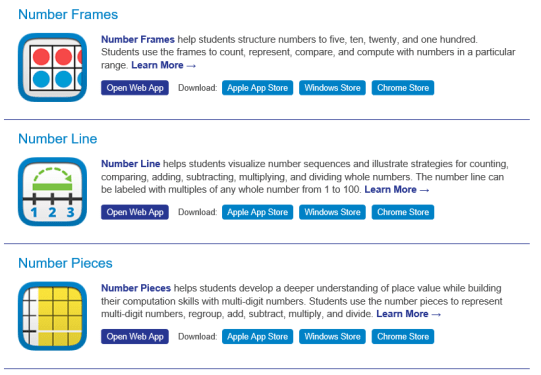
These apps are amazing! So many to choose from to help students conceptually understand mathematics. There are number lines, geoboards, money pieces with a number rack, rekenreks, ten frames, pattern blocks and more! Just allowing your child to play with these apps will enhance their understanding of number! Here are just a few from the site:math learning center 2

 Finally, this is a book that came highly recommended. Though not free, it can be a support for parents in navigating Common Core mathematics. (It does come with videos as well!)CCSS Math

http://www.amazon.com/Common-Parents-Dummies-Videos-Online/dp/1119013933

Cool Tools for Kids in Math

Response to Confusion 43-13

So today a friend tagged me in a FB post regarding the “frightening” method that students MUST solve subtraction problems. I have posted the link below, and I believe the link is at the bottom of this post as well! Take a look.

So let’s summarize the tutor’s concerns. 1. That we are writing problems horizontally rather than vertically. 2. That students are using a strategy of “adding up” rather than “stack and subtract”. 3. They MUST use this strategy and no other.

I would like to address each of these and provide some comments.

  1. Most of us are used to seeing math problems vertically. Why? Well, for one, it makes the problem ready to go for  the algorithm  of “stack and subtract” (which is not the ONLY algorithm in the world, mind you). I would contend it also saves space for publishing companies in their workbooks. If the problem is already written for the algorithm, publishers do not have to provide additional space and therefore can fit more problems on a page, and save money. (Yeah, I went there. Bring on the comments!) However, when you write a subtraction problem vertically, you lose the essence of the numbers.   IMG_7211Here I only see single digit subtracted by single digit. I do not see 40 – 20, but 4 – 2 and 5 – 1. This is okay for problems where we do not have regrouping. However, some students get so stuck in the process of regrouping that they no longer see the value of the places and just write a very ‘random’ value as the difference. When I write the problem horizontally (45-21), it allows me to view it from a place value perspective. My eyes look first at the tens and then the ones, versus the horizontal example where I start with the ones and then look at the tens. Also, writing it horizontally does not constrict me to a “stack and subtract” method. (See prior blog for more info on great subtraction strategies to help kiddos.) Really, both are fine; no need to get all uppity about it. And if a teacher says they HAVE  to write it that way, it is not true, but what is true is that they learn to think about relationships and different strategies using place value and properties of numbers BEFORE learning the standard algorithm. In fact, the standard algorithm for multi-digit subtraction should not be mastered until grade 3: CCSS.Math.Content.3.NBT.A.2
    Fluently add and subtract within 1000 using strategies and algorithms based on place value, properties of operations, and/or the relationship between addition and subtraction. So students have lots and lots of time to process what it means to subtract and its relationship to addition.
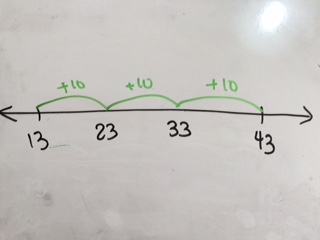
  2. (and 3.) Adding up is one strategy students can use. Makes sense to me! If I already know how to add, I can simply use that to help me figure out the missing addend. This is all a subtraction problem really is: a missing addend problem! Consider the following: 43 – 16. This is really finding out 16 + ____ = 43. Now typically, students do not need to go to the next five as the tutor suggests. And really a number line is FABULOUS for modeling adding up. Here is one way to get the value. IMG_7213Notice this is a great strategy for students who struggle with regrouping, because there IS NO REGROUPING!!!  I went up 4 to the nearest ten (20), added 20 more (40), and ‘hopped’ 3 more to get to my end point (43). 4 + 20 + 3 is 27. Therefore, 43 -16 = 27.                                                               Using the tutor’s problem (43-13), I think adding up is efficient, if you move up by tens. I can simply add by tensIMG_7214 until I reach 43. 3-tens is 30. Not sure why it is so convoluted in her explanation and NO! Students do not have to add up the same way the tutor did. In fact, that is the wonderful thing about Common Core. CCSS.Math.Content.2.NBT.B.7
    Add and subtract within 1000, using concrete models or drawings and strategies based on place value, properties of operations, and/or the relationship between addition and subtraction; relate the strategy to a written method. Understand that in adding or subtracting three-digit numbers, one adds or subtracts hundreds and hundreds, tens and tens, ones and ones; and sometimes it is necessary to compose or decompose tens or hundreds. Notice that students can use any method, with or without drawings or concrete models!!! Super awesome! Hooray for creativity! I no longer have to use one method (that I don’t really get and just memorized because my teacher told me to); I can use any method so long as I keep in mind place value and my rules (properties).
“Our classrooms are filled with students and adults who think of mathematics as rules and procedures to memorize without understanding the numerical relationships that provide the foundation for these rules. The teaching of mathematics has been viewed as a discrete set of rules and procedures to be implemented with speed and accuracy but without necessarily understanding mathematical logic. For the majority of our nation, knowledge of mathematical rules has not allowed them to use math confidently in their daily lives. With almost two-thirds of the nation’s adult population fearful of mathematics, they have simply said “NO” to math and closed the doors to careers that require higher math” (Burns, 1998; Parrish, 2010).
Let’s allow students to make sense of number relationships, what the operations MEAN, and figure out what makes sense and how to approach the mathematics based on the numbers given.


Response to Confusion 43-13

Start Smart! 6 Things Your Child Can Do To Start The Year Right

You know it’s almost here! The smell of newly sharpened pencils and the odor of dry erase pens…The aisles of school supplies in the local stores…Sales on children’s clothing…School is upon us! Here are some tips for you to encourage your child to do to get the year off to a great start in their math class!

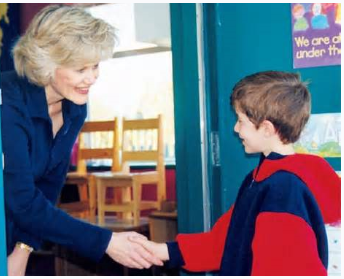
Greet the Teacher1. Greet your teacher the first day. I cannot stress the importance of making a good first impression. This is especially important in middle school, where we teachers have over 180 students to remember!  Encourage your child to make eye contact with his teacher and shake her hand. Say, “My name is ________ and I look forward to being in your class!”

2. Sit in the front! Now, some teachers choose your seats for you. If they do not, choose a seat in the first two rows. It forces you to listen, and you have first crack at your teacher if you don’t understand something.Sit in Front

3. S.L.A.N.T. This is a behavioral routine (I learned about it when I was an AVID teacher) used by many school districts to encourage positive engagement in class. (For more information, visit http://www.powayusd.com/teachers/lharvey/path/slant.htm)

SSit Up – Sitting with your feet flat on the floor, back straight, and facing forward focuses you and puts you in the right mindset to work and take part in discussions.            

LLean Forward- Leaning forward shows you are engaged in the lesson, which often encourages teachers to ask you questions, see how you are doing,  and keep you engaged.

AAsk Questions- I can guarantee you are not the only one with your question. However, by being the bold one to ask it, the teacher knows you are listening and that you care. In turn, she will take more time with you to make sure you understand.

NNod Yes/No- The simple act of nodding when you agree/disagree lets the teacher know you are listening and what you are thinking.

TTalk With Teachers- We are real people. Talk to us. The more we know you, the more we care about you.

HW4. Write your homework down. The most common reason I get for students not doing their HW is that they didn’t know what it was. Get in the habit of coming in and immediately pulling out your planner to write down your HW. When you do your HW, highlight it to indicate it is complete.

5. Do your homework! Start off right. Get in the habit of doing your HW. If you don’t understand it, try it for at least 20 minutes and email your teacher to let her know what you tried and where you got stuck. Just putting in the effort will let your teacher know you care. The more you care, the more we care about helping you.

6. Don’t be absent. Miss school, miss out. You simply cannot make up the discussions and learning that took place on a day you missed. The more school you miss, the more you don’t understand, the more you dislike school, the more likely you will drop out.Absent

Have a great first week of school!

Up next: Questions to Ask Your Child To Help With HW!

Start Smart! 6 Things Your Child Can Do To Start The Year Right

Top 5 Things NEVER to Do/Say AGAIN When Helping Your Child With Math!!!

What we want is to see the child in pursuit of knowledge, and not knowledge in pursuit of the child.   

George Bernard Shaw

Happy Teacher Appreciation Week!!! I had a blog all good to go with stories from my own edcuational journey, my son’s, and others. Yet it didn’t seem to fit my purpose, which is to support parents in helping their children with math. So I decided to let y’all in on some secrets. Here are the top 5 things teachers wished you would never do (or say) when helping with math. Likewise, here are the top 3 things teachers wished you would always do when supporting your child in math.

Top 5 Things NEVER To Do Again When You Help Your Child With Math

  1. 7cd05c2267bceac7ba2101dc4624d14dNever say, “I wasn’t good at math.” This goes for teachers that do not teach mathematics as well! In fact, on my most recent blog, many responded (on FB) that they were never good at math, nor would they be good at math now. This self-deprecation has to stop NOW!!! This is a cop-out, and it allows your child to think it is okay to be illnumeric (Yeah, totally made up that word.) Would you admit to your child that you couldn’t read or write? Would that be acceptable in your home for your child not to be able to read or write? Heck no! So just stop.
  2. thDVCZDEMMNEVER say the homework is stupid, boring, ridiculous, etc. in front of your child. Jo Boaler, a mathematician out of Stanford University, has done a ton of research on the correlation between student effort and performance in mathematics. Bottom line: the more effort you put in, the better you do. To learn mathematics takes effort, time, and perseverance. You may not like what your child is doing, but relay that message to the teacher, not your child. And please do not write a derogatory note on your child’s homework. This negativity leads your child to believe that he can choose to do some work and skip other work because it is uncomfortable. Would that fly in a job atmosphere? Can I choose to do some of my job-related work and ditch the rest because it is boring? NO, I cannot. Please, support your child at home. Encourage him to try his hardest. “Play” with the problems. And if he goes over the research-based homework time (According to Robert Marzano, 10 minutes per grade level. So for grade 3, 30 min.) take a break, and email his teacher.
  3. 185255772NEVER do the homework for your child! My favorite story about this was with a young lady who was perfectly capable of doing the homework, but got stuck and didn’t know what to do. She asked her father for help. He literally took the pencil from her daughter and wrote it out for her. You could see on the page where she stopped and he began. When I pulled her aside and asked her, she said, “Well, he thought I couldn’t do it so he did it for me.” What did that teach her? When it gets too tough, give up and assume someone else will do it for you? If you want to help, ask questions. But don’t give answers.
  4. stopwatchNEVER EVER attribute brilliance with speed! I am at fault for this. When a toddler can do something quickly, how do we respond? “Wow! You are so SMART.” No, you just already knew how to do it. Children are brought up thinking if they don’t know the answer to a math problem immediately, they are dumb. That is sooo not true!!! Mathematics takes deep focus, diligence, and perseverance. Encourage effort, not speed.
  5. thJ6P17D2JNEVER make excuses for your child to get out of the work. Look, life happens. We teachers get it. Things come up. We love it when you communicate with us, especially when unforeseen circumstances arise. However, your child is still responsible for the work. It may be late, but should still be done. I used to cringe when my middle school student would come in with a big ol’ grin and say, “My mom said I didn’t have to do this and here is the note!” Work it out with the teacher, not your child.

Top 3 Things To Do Right Now To Support Your Child in Math

  1. you can do itEncourage effort. When your child gets frustrated, you can absolutely say that math was tough for you too. BUT MOVE ON. What are the resources she has to support the homework? Was she given examples in notes? Did she already do some of the problems (to look at to refresh her memory)? Are there videos on-line to help? BTW: Many publishers have on-line support via tutorials. Ask your teacher for the link, login and password! Does your teacher offer tutoring? Encourage your child to attend. All of these resources will continue as she moves through education. These are great tools to learn how to access now!
  2. QuestionsAsk questions. My favorite story was of a grandfather who took care of his granddaughter after school. She ended up getting her doctorate (I believe). When asked what contributed to her success, she said it was all the help her grandfather gave her with her homework throughout her time in school. Little did she know, her grandfather was illiterate. He simply helped through questioning. You don’t have to know the math. You need to have good questions to ask.
    • What homework did you have in math today? Show it to me. (Yes, even my child has said his homework is done and…ooops! Still have a few problems left to do…)
    • Tell me what you have tried and where you think you are getting stuck. (Not a question, but a great place to start.)
    • What did you learn in class today that could help you with this? Let’s look it up in the index (if they have a book at home) and see if we can go through the lesson together.
    • Do you have notes from today? Let’s re-read them and see if they can help us.
    • Do you have a problem already done? Let’s go through the steps and see if that refreshes your thoughts.
    • What do you know? Where are you stuck in the problem?
    • Could we go online and look up how to do _______?
    • Who could you call to ask for help? Could you meet with them before school/lunch/etc? (I offered my room for study groups. Kids would come and work together on the homework. Awesome to listen to them help each other!)
    • When does your teacher offer tutoring? Let’s take you to get some support.
  3. Parent teacher ConferenceBe in communication with your teacher. You are your child’s greatest advocate. This is critical in middle and high school, where teachers have up to 200 students a day! Email the teacher when your child is stuck. When he is frustrated. When things get difficult at home. When we had our second child (ten years later), my oldest started slipping in school. I emailed his teachers what was happening, and they were super supportive, giving him the attention and help he needed to get back on track. Teachers do not know what is going on in their students’ outside lives unless you help them know. Help your child by keeping the lines of communication open!

Notice none of my suggestions encouraged you to become a mathematician. Just be a support for your child, encourage effort, and keep in contact with his teacher. These are the greatest gifts you can give a teacher (and your child!). THANKS!!!


To read more from Jo Boaler: http://www.youcubed.org/

Top 5 Things NEVER to Do/Say AGAIN When Helping Your Child With Math!!!

Learning Multiplication Facts Fluently: Resources

I  was hoping to have this post up a few days ago. However, I have been deeply disappointed with the lack of resources for students to truly gain an understanding of what multiplication IS. My least favorite involved rhymes for EVERY fact that had absolutely nothing to do with multiplication! (4 door x 6 chicks= denty floor, 24. Are you kidding me????)

There are a ton of “just fact” games: give the fact, type in the product, and so on. And these are fine for students who already know their facts. But if your child is struggling to learn their multiplication facts, that is the LAST place you want to go! So I am going to provide some alternatives for you to explore.

Before I do, I want you to truly ask yourself this question. Does your child REALLY know the facts, or is she merely skip counting quickly? This question could also be asked of your first grader with addition. (Does he really know his addition facts, or is he counting by ones really fast?) When you ask your child a multiplication fact, does she tap it out, count on her fingers, or (what my middle school students would do ) bounce through the multiples? Let me give you an example: 3 x 7. Does your child bounce through (3, 6, 9, 12, 15, 18, 21…21!)? If so, she was timed too early in learning her multiplication facts. Your child should not be timed until she can use a strategy or just knows the fact within three seconds. And that is one-one thousand, two-one thousand, three-one thousand. Once they can multiply that quickly, you can go to some of these fun blast ‘em multiplication games.

So how can you help get her to three seconds? Here are three games I used with my son. I used them in this order, as they get more difficult and begin to have a sort of time crunch to them. If you have others, especially great apps, please include them in the comments section. If you add a resource, please let us know if it is to review mastery or to build strategies towards mastery. Thanks!

1. Circles and Stars. I have seen this in a number of mathematics resources, but the one I love is from Marilyn Burns (see link below). This is slightly adapted. All you need are two dice, paper and a pencil (or whiteboard and marker, which is my personal choice).

Roll two dice. The first number tells you how many circles to draw. The second number tells you how many stars to draw in EACH circle. The total number of stars is your product. Play 5 rounds. The person with the most stars at the end of 5 rounds wins.

Example: Sam rolls a 3 and a 4. He draws 3 circles, with 4 stars in each circle. There are twelve stars in all. 3 x 4 = 12.

Take it one step further. Roll two dice. You choose which number represents the circles and which number represents the number of stars in EACH circle. At some point, you want to ask your child, “Does it matter?” “Will I get the same amount of stars in the total?” The answer is yes! However, 5 circles with 2 stars in each circle looks different than 2 circles with 5 stars in each circle. Yet they both give me 10 stars in all. This is a great place to discuss the commutative property. For multiplication (and addition), when I reverse the order of my factors (the numbers I am multiplying together), I will get the same result. So if your child knows 3 x 7, but thinks he doesn’t know 7 x 3, think again!

2. Math Boggle! I loved Boggle growing up. Shake up the letters, and try to find as many words as you could in the time allotted. This helped me a great deal with learning to spell. Well, we need to play with numbers just like we play with letters. We are just going to start with one fact, and try to figure out as many strategies in the time allotted to find the product (the answer to a multiplication problem). Your kids may know this as a “Number Talk” if their teacher uses them as warm-ups. (If not, encourage them to do so!)

Example: 5 x 6. You have five minutes to find as many different ways to get the value. Go!

  1. 5 + 5 + 5 + 5 + 5 + 5= 30 (Still reliable and true, but not the fastest method.)
  2. 6 + 6 + 6 + 6 + 6 = 30 (Great to have a discussion as to which method, a or b, is more efficient and discuss the commutative property yet again.)
  3. 5 x (2 x 3) = 10 x 3 = 30 (I factored the 6 into 2 x 3. You know it as taking the prime factorization of 4. It’s actually a useful tool when working with multiplication and division.)
  4. 5 x (3 + 3) = (5 x 3) + (5 + 3) = 15 + 15 = 30. This is using the distributive property. Please see prior post for details! Also notice it is 15 twice, which could lead to the next strategy.
  5. 5 x (3 x 2) = 15 x 2 = 30. Similar to c, but using the commutative property. Also, similar to d, as I have 15 two times. This leads to a nice discussion about why we break apart the 6 instead of the 5. The number 6 is composite; it can be broken into the product of primes. 5 is prime, so it cannot be broken down into smaller whole numbers through multiplication.
  6. 5 x (4 + 2) = (5 x 4) + (5 x 2) = 20 + 10 = 30. Again, using distributive property, but I broke up the 6 differently.
  7. 5 x (5 + 1) = 25 + 5 = 30. Distributive property. Notice I stopped writing in the middle step. Once kids understand what is going on (in this case, I am multiplying the 5 times the 5 and then the 5 times the 1), they can omit this step. The goal is to get as many as you can. Further, we are eventually wanting them to do most of this in their head so they know their facts.
  8. (2 + 3) x 6 = (2 x 6) + (3 x 6) = 12 + 18 = 30. You can use distributive property by breaking up the 5, but notice the partial products you get (12 and 18) are tougher to add together in your head. Great place to talk about why we naturally break apart the 6 instead of the 5.
  9. There are many others, but I am hoping you get the idea.

You can play this all day long! Just use a whiteboard and work as a team. Take 5 minutes to work alone. Discuss all of the different strategies each of you used. Perhaps work together to find one more. Go to a different fact. Play in the car (Obviously the kids are playing, not you while driving!), while waiting for an appointment, at a restaurant. The more you play with numbers with your kids, the more fun they have, and the more important they see numbers playing a role in their lives.

3. The Product Game: http://illuminations.nctm.org/Lesson.aspx?id=5729

This is the first of four different multiplication activities your child can do with you to learn multiplication fluently. I highly recommend playing this after your child has really worked with the first two activities. The directions are included on the site as well as a pdf of the game you can print out. You are basically taking two numbers and multiplying them together to earn a spot on the grid. The first person to get four in a row (like tic-tac-toe), wins. Have a whiteboard or scratch paper handy in case your child wants to use some of their strategies to figure out the products. The other activities can be found through this link: http://illuminations.nctm.org/unit.aspx?id=6104

If you only have time or energy for one of these three activities, please use #2. It gets you the most bang for your buck. Happy number playing!!!


Teachers: For a great resource for multiplication please check out Lessons for Introducing Multiplication, Grade 3 by Marilyn Burns (2001)


Learning Multiplication Facts Fluently: Resources