‘Tis the season in Kindergarten for learning addition and subtraction. You may wonder where your child is with respect to these foundational operations. Most educators will think about their students’ learning of single digit addition/subtraction as a 3-level progression. I will focus on addition for sake of space.
Level 1: Counting All
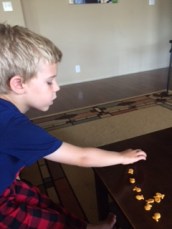
This is where most kinders should be. They can even end the year in this level and be awesome! At Counting All, students typically use concrete objects to count one-by-one in order to find the sum. Below is an example, using 2 + 3.
Level 2: Counting On
This is the “trap and keep” idea. The first addend is “trapped” in your mind, and you count on from that value. This is a more sophisticated idea, because you have to understand that the first addend is a quantity of its own, and you are moving forwards from that value (versus starting at 1 every time). Often your child will “trap and keep” the first addend by taking their hand to their head to “trap” it in their mind, then use their fingers to count on. So for 5 + 3, they would “trap the 5” and count on, “siiix….sevennnnn…eighhhht”. This is a level many children live in for quite some time.
Level 3: “Messing with Math!”
That is actually NOT what it’s called, but I like this title much more! This is when children start realizing that there are certain “cheats” that they can use to do more of the math in their head. (Mathematically, they are called properties, but that is for another blog!) I will actually devote an entire set of blogs for this Level, as it is that important. But for now, here is an example using ten-frames with the expression, 9 + 5.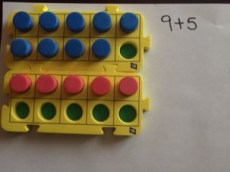
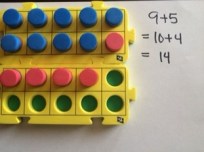 Students can see that, if they take one of the five (reds) and move it up with the nine (blues), they can make a 10. 9+5 can be renamed as 10+4=14. This is HUGE for students in terms of flexibility with numbers and algebraic thinking!
Children will ebb and flow between these three levels. The important thing is to play, explore, and play some more! The next few blogs will encourage this through games that I am trying out with my son’s Kinder class!!!
For more information, please visit: https://www.cde.ca.gov/ci/ma/cf/documents/mathfw-appendixc.pdf (This is one of the best versions…Go CA Framework Committee!)
For the ten-frames (I love these because they are soft and quiet!): https://www.schoolspecialty.com/magnetic-board-set-1400695
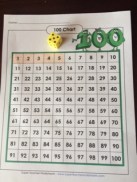
 count is a BIG DEAL!
 Mine (as I am on the lazy side) typically look like a rectangle with an opening at the top (for the input) and an opening at the bottom (for the output). They are just very boring and sad. The one to the right is super cute and soooo not me.
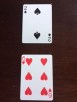
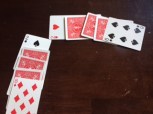
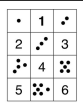 goes faster and they are working only with 2, 3, 4, and 5. You can use the aces as 1. Even better, use number cards or dot cards (see below for links). Print on cardstock (4 cards per number) or go online and buy a set.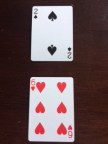


 Geogebra:
 Math Learning Center: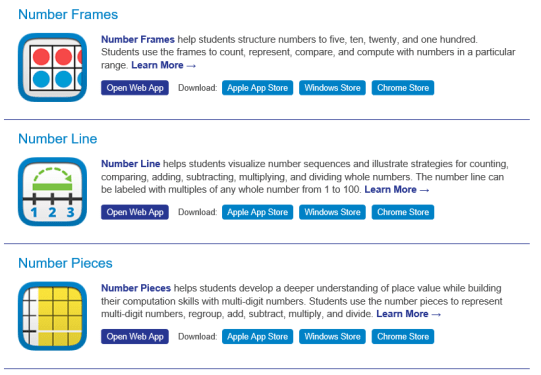
 Here I only see single digit subtracted by single digit. I do not see 40 – 20, but 4 – 2 and 5 – 1. This is okay for problems where we do not have regrouping. However, some students get so stuck in the process of regrouping that they no longer see the value of the places and just write a very ‘random’ value as the difference. When I write the problem horizontally (45-21), it allows me to view it from a place value perspective. My eyes look first at the tens and then the ones, versus the horizontal example where I start with the ones and then look at the tens. Also, writing it horizontally does not constrict me to a “stack and subtract” method. (See prior blog for more info on great subtraction strategies to help kiddos.) Really, both are fine; no need to get all uppity about it. And if a teacher says they HAVE to write it that way, it is not true, but what is true is that they learn to think about relationships and different strategies using place value and properties of numbers BEFORE learning the standard algorithm. In fact, the standard algorithm for multi-digit subtraction should not be mastered until grade 3:
  Notice this is a great strategy for students who struggle with regrouping, because there IS NO REGROUPING!!! I went up 4 to the nearest ten (20), added 20 more (40), and ‘hopped’ 3 more to get to my end point (43). 4 + 20 + 3 is 27. Therefore, 43 -16 = 27. Using the tutor’s problem (43-13), I think adding up is efficient, if you move up by tens. I can simply add by tens
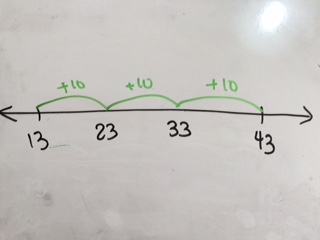 until I reach 43. 3-tens is 30. Not sure why it is so convoluted in her explanation and NO! Students do not have to add up the same way the tutor did. In fact, that is the wonderful thing about Common Core.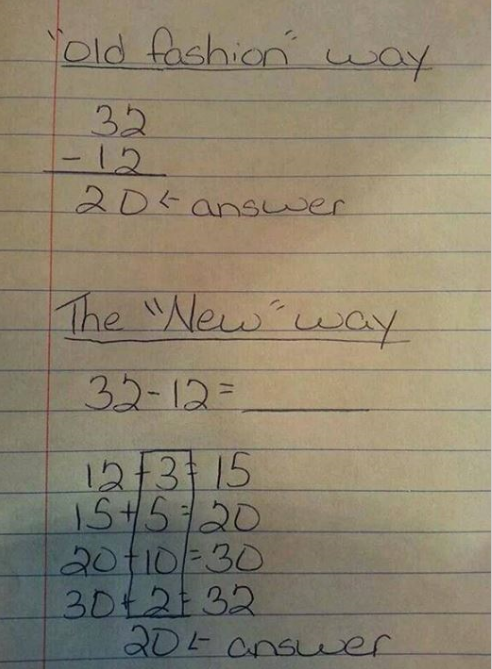
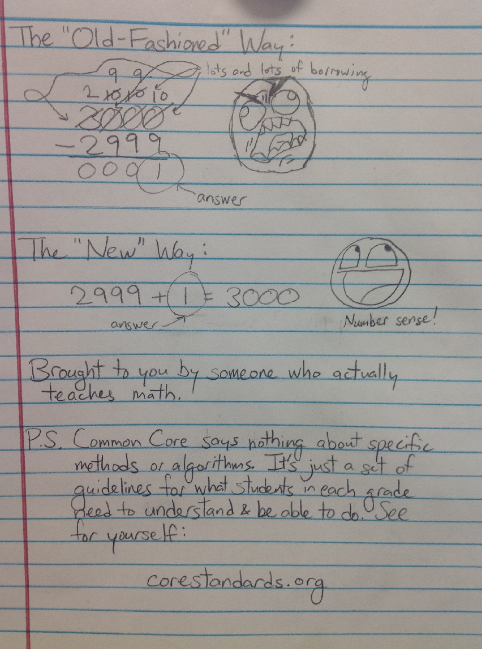

 moffett4understandingmath