Taking The Distributive Property to Middle School: Making Multiplying Mixed Numbers Easier!

The last couple of blogs have highlighted the importance of the distributive property in multiplication for grades 3-8.  Let’s refresh ourselves…

Example: 6 x 9    Try it out using the distributive property! (There are many, but I have highlighted two.)

Method 1: Think about the 9 as (10 – 1).  Distribute (multiply everything in the parenthesis by) the 6.

 6 x (10 – 1) = (6 x 10) – (6 x 1) = 60 – 6 = 54

Method 2: Think about 9 as (4 + 5). Distribute the 6.

6 x (4 + 5) = (6 x 4) + (6 x 5) = 24 + 30 = 54

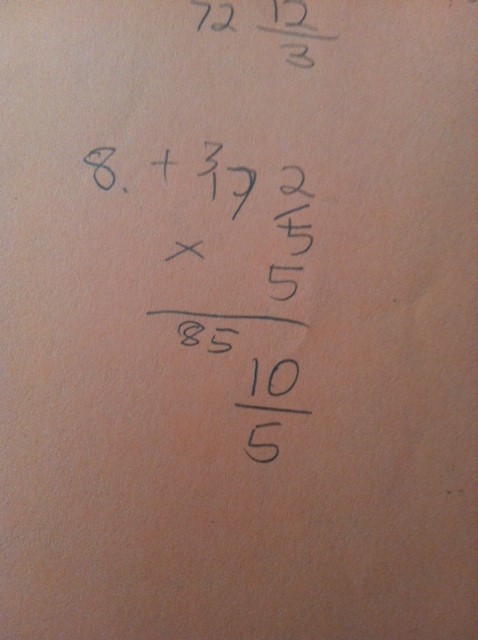
So you may think, “Jen, where the heck are you going with this?! This is a waste of my time and my child’s time.” Yet here was my son’s homework earlier this year.
multiplying mixed number

He was to multiply 17 2/5 by 5. Most of us learned you MUST convert the mixed number (17 2/5) to an improper fraction, then “multiply tops/multiply bottoms”. Finally change the improper fraction BACK TO A MIXED NUMBER. What a stinkin’ waste of time!

My oldest had the problem done in less than a minute. He got 87. Do you see it? What did he do? I have to admit I didn’t see it at first, and had to ask him. This is what he said (please insert a very monotone voice, since he wasn’t pleased with having to tell his mother his strategy…)

I thought about the 17 2/5 as two parts. 17 + 2/5. I mutliplied 5 times 17 and then 5 times the 2/5. Then I put it back together. (Duh, mom.)

So what does this look like mathematically?

5 x 17 2/5 = 5 x (17 + 2/5)

                                                 5 x (17 + 2/5) = (5 x 17) + (5 x 2/5) = 85 + 10/5 = 85 + 2 = 87.

In this case, using the distributive property is MUCH faster than the rules we were taught! And it makes sense! I am using partial products. I break up my number into easier parts, multiply them by the given value, and put it back together.

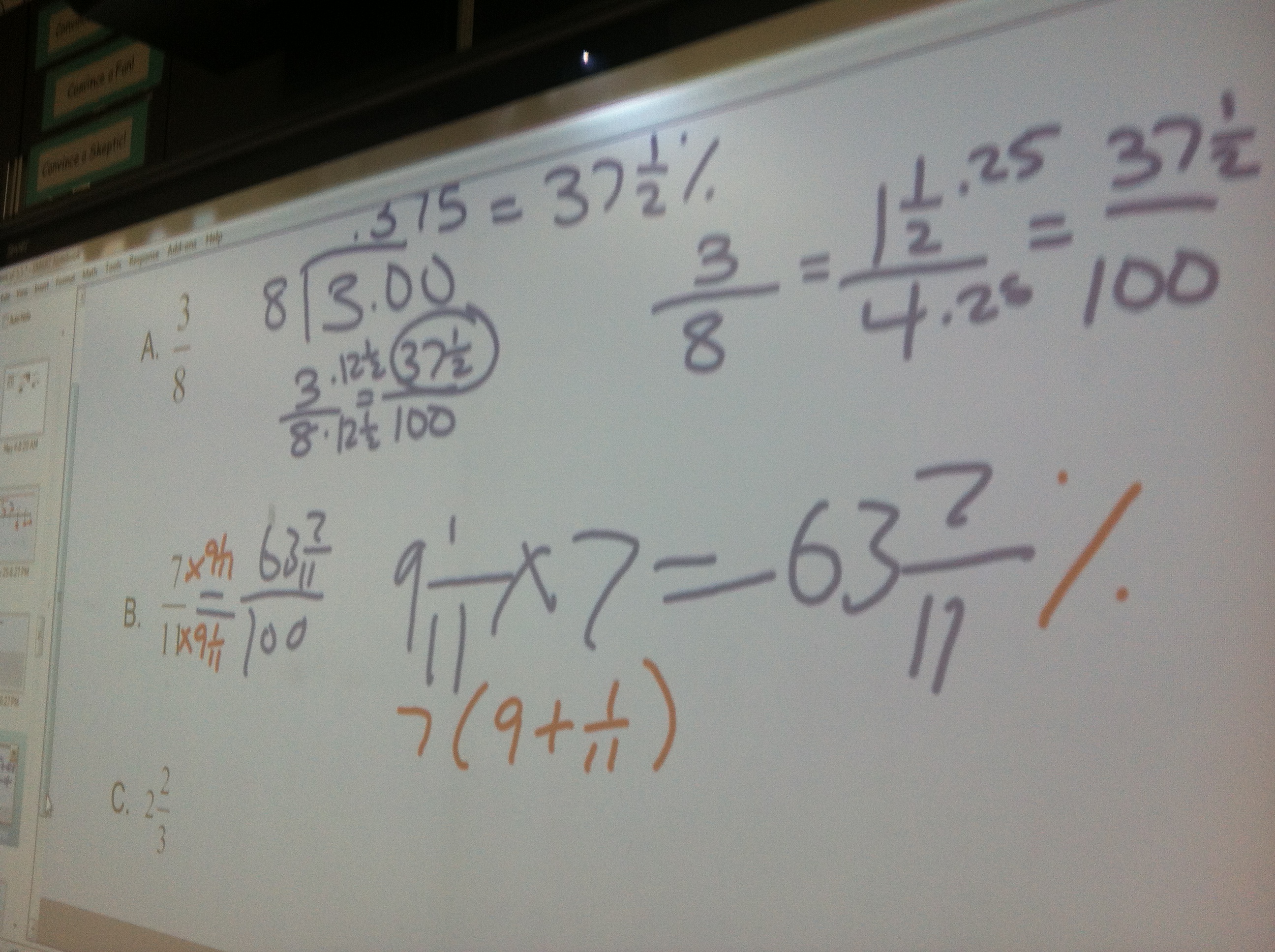
Here is another example. This came from one of my intervention students (students who are brilliant but don’t excel with the traditional book method in mathematics…) :
Import 9.3.14 709

You can admire all of his fabulousness, but the piece I want to focus on is 9 1/11 x 7. In red, notice he rewrote it for everyone to understand. Please note he had done it in his head (the blue). All red work was written after to let his class know what he was thinking.

                                  9 1/11 x 7 = 7 x 9 1/11 (commutative property)

7 x 9 1/11 = 7 x (9 + 1/11)

                                     7 x (9 + 1/11) = (7 x 9) + (7 x 1/11) (distributive property)

                         = 63 + 7/11 = 63 7/11%

Why am I showing you this? As parents, you WILL see the distributive property used with fractions, decimals, and percents. It makes it faster to compute, as students can do most of it in their heads. Most important, when students use the distribute property, I have noticed less “silly” errors. They get it right because it makes sense!

What can you do to support this kind of thinking? Play with numbers. Use a whiteboard. Use the sidewalk with chalk. Use the bathroom mirror with a dry erase pen. Give one problem a day and see how easy it gets to think about multiplication this way.

Here are some starter problems…

7 x 6, 7 x 7, 7 x 8, 7 x 9, 7 x 12 (break the 12 into 10 and 2)

8 x 4, 8 x 6, 8 x 7, 8 x 9, 8 x 12

9 x 4, 9 x 6, 9 x 7, 9 x 8, 9 x 12

3 x 16 (break into 10 + 6), 3 x 17, 3 x 18, …You could go on forever!

2 x 4 1/2, 2 x 5 1/2, 2 x 6 1/2, ….and so on

3 x 4 1/3, 3 x 4 2/3, 3 x 5 1/3, 3 x 5 2/3, …and so on

4 x 3 1/4, 4 x 3 1/2, 4 x 3 3/4, … and so on

If you need more, just look up free worksheets that multiply a mixed number by a whole number. Use one a day!

Taking The Distributive Property to Middle School: Making Multiplying Mixed Numbers Easier!

Learning Multiplication Facts Fluently: Resources

I  was hoping to have this post up a few days ago. However, I have been deeply disappointed with the lack of resources for students to truly gain an understanding of what multiplication IS. My least favorite involved rhymes for EVERY fact that had absolutely nothing to do with multiplication! (4 door x 6 chicks= denty floor, 24. Are you kidding me????)

There are a ton of “just fact” games: give the fact, type in the product, and so on. And these are fine for students who already know their facts. But if your child is struggling to learn their multiplication facts, that is the LAST place you want to go! So I am going to provide some alternatives for you to explore.

Before I do, I want you to truly ask yourself this question. Does your child REALLY know the facts, or is she merely skip counting quickly? This question could also be asked of your first grader with addition. (Does he really know his addition facts, or is he counting by ones really fast?) When you ask your child a multiplication fact, does she tap it out, count on her fingers, or (what my middle school students would do ) bounce through the multiples? Let me give you an example: 3 x 7. Does your child bounce through (3, 6, 9, 12, 15, 18, 21…21!)? If so, she was timed too early in learning her multiplication facts. Your child should not be timed until she can use a strategy or just knows the fact within three seconds. And that is one-one thousand, two-one thousand, three-one thousand. Once they can multiply that quickly, you can go to some of these fun blast ‘em multiplication games.

So how can you help get her to three seconds? Here are three games I used with my son. I used them in this order, as they get more difficult and begin to have a sort of time crunch to them. If you have others, especially great apps, please include them in the comments section. If you add a resource, please let us know if it is to review mastery or to build strategies towards mastery. Thanks!

1. Circles and Stars. I have seen this in a number of mathematics resources, but the one I love is from Marilyn Burns (see link below). This is slightly adapted. All you need are two dice, paper and a pencil (or whiteboard and marker, which is my personal choice).

Roll two dice. The first number tells you how many circles to draw. The second number tells you how many stars to draw in EACH circle. The total number of stars is your product. Play 5 rounds. The person with the most stars at the end of 5 rounds wins.

Example: Sam rolls a 3 and a 4. He draws 3 circles, with 4 stars in each circle. There are twelve stars in all. 3 x 4 = 12.

Take it one step further. Roll two dice. You choose which number represents the circles and which number represents the number of stars in EACH circle. At some point, you want to ask your child, “Does it matter?” “Will I get the same amount of stars in the total?” The answer is yes! However, 5 circles with 2 stars in each circle looks different than 2 circles with 5 stars in each circle. Yet they both give me 10 stars in all. This is a great place to discuss the commutative property. For multiplication (and addition), when I reverse the order of my factors (the numbers I am multiplying together), I will get the same result. So if your child knows 3 x 7, but thinks he doesn’t know 7 x 3, think again!

2. Math Boggle! I loved Boggle growing up. Shake up the letters, and try to find as many words as you could in the time allotted. This helped me a great deal with learning to spell. Well, we need to play with numbers just like we play with letters. We are just going to start with one fact, and try to figure out as many strategies in the time allotted to find the product (the answer to a multiplication problem). Your kids may know this as a “Number Talk” if their teacher uses them as warm-ups. (If not, encourage them to do so!)

Example: 5 x 6. You have five minutes to find as many different ways to get the value. Go!

  1. 5 + 5 + 5 + 5 + 5 + 5= 30 (Still reliable and true, but not the fastest method.)
  2. 6 + 6 + 6 + 6 + 6 = 30 (Great to have a discussion as to which method, a or b, is more efficient and discuss the commutative property yet again.)
  3. 5 x (2 x 3) = 10 x 3 = 30 (I factored the 6 into 2 x 3. You know it as taking the prime factorization of 4. It’s actually a useful tool when working with multiplication and division.)
  4. 5 x (3 + 3) = (5 x 3) + (5 + 3) = 15 + 15 = 30. This is using the distributive property. Please see prior post for details! Also notice it is 15 twice, which could lead to the next strategy.
  5. 5 x (3 x 2) = 15 x 2 = 30. Similar to c, but using the commutative property. Also, similar to d, as I have 15 two times. This leads to a nice discussion about why we break apart the 6 instead of the 5. The number 6 is composite; it can be broken into the product of primes. 5 is prime, so it cannot be broken down into smaller whole numbers through multiplication.
  6. 5 x (4 + 2) = (5 x 4) + (5 x 2) = 20 + 10 = 30. Again, using distributive property, but I broke up the 6 differently.
  7. 5 x (5 + 1) = 25 + 5 = 30. Distributive property. Notice I stopped writing in the middle step. Once kids understand what is going on (in this case, I am multiplying the 5 times the 5 and then the 5 times the 1), they can omit this step. The goal is to get as many as you can. Further, we are eventually wanting them to do most of this in their head so they know their facts.
  8. (2 + 3) x 6 = (2 x 6) + (3 x 6) = 12 + 18 = 30. You can use distributive property by breaking up the 5, but notice the partial products you get (12 and 18) are tougher to add together in your head. Great place to talk about why we naturally break apart the 6 instead of the 5.
  9. There are many others, but I am hoping you get the idea.

You can play this all day long! Just use a whiteboard and work as a team. Take 5 minutes to work alone. Discuss all of the different strategies each of you used. Perhaps work together to find one more. Go to a different fact. Play in the car (Obviously the kids are playing, not you while driving!), while waiting for an appointment, at a restaurant. The more you play with numbers with your kids, the more fun they have, and the more important they see numbers playing a role in their lives.

3. The Product Game: http://illuminations.nctm.org/Lesson.aspx?id=5729

This is the first of four different multiplication activities your child can do with you to learn multiplication fluently. I highly recommend playing this after your child has really worked with the first two activities. The directions are included on the site as well as a pdf of the game you can print out. You are basically taking two numbers and multiplying them together to earn a spot on the grid. The first person to get four in a row (like tic-tac-toe), wins. Have a whiteboard or scratch paper handy in case your child wants to use some of their strategies to figure out the products. The other activities can be found through this link: http://illuminations.nctm.org/unit.aspx?id=6104

If you only have time or energy for one of these three activities, please use #2. It gets you the most bang for your buck. Happy number playing!!!


Teachers: For a great resource for multiplication please check out Lessons for Introducing Multiplication, Grade 3 by Marilyn Burns (2001)


Learning Multiplication Facts Fluently: Resources

Fluency in Multiplication: Why Your Child Needs To Know How to Distribute!

This is the third in a series regarding fluency of basic facts. For the introduction to this series, please read Fluency and Memorization Are Not Synonyms!!!

I am a believer that all students can be successful in understanding mathematics. Maybe not memorizing erronerous facts, but truly understanding what the numbers mean and how they relate to one another. One of my favorite interviews to do with my sixth graders is on multiplication facts. You may want to ask your child this question as well…

If I know that 7 x 6 is 42, how does that help me figure out what 7 x 7 is?

Most students will say “49”, but will not find the relationship between the two facts. Here are the common answers for my sixth graders:

1. “I just know it.”

2. (Counting each one on his/her fingers) “7, 14, 21, 28, (usually begins counting by ones), 29, 30, 31, 32, 33, 34, 35, 36, 37, 38, 39, 40, 41, 42, 49…7 x 7 is 49.”

3. Gets the answer wrong, or says he/she does not know that one.

Now don’t get me wrong, I am appreciative when a student “just knows it”, because it usually makes her life easier. The middle school years are ALLLL about multiplicative thinking and proportional reasoning. If you do not know your multiplication facts fluently, you spend sooo much time figuring out the fact (such as student #2) you get lost in the actual work you are trying to do. This leads to frustration, feelings of failure, and a negative attitude towards mathematics.

The answer I am looking for is similar to the following.

“I can just add one more group of 7 to 42 and get 49.”

Why is this important? Because many children do not see multiplication of whole numbers as simply a certain number of equal groups. 7 x 6 means that I either have 7 groups of 6 OR 6 groups of 7 (Commutative Property. Please see my blog on fluency with addition facts.) So if I have 7 x 7, I have one more group of 7 than I did before.

Mathematically, it looks like this: 7 x 7 =(7 x 6) + (7 x 1) = 42 (the fact I was given) + 7 = 49.

This type of strategy, doing your multiplication in parts, is often called in elementary books the partial products. In middle school, this particular set of partial products is called the distributive property. It means you are going to distribute (pass out) a number, multiplying it by everything it has a relationship to. This is not new. We used this in Algebra back in the day. But to use it to help with multiplication facts is a novel idea for most, though it brings understanding to what they are learning.

Here is another example: 6 x 9. (One of the most commonly missed facts.)

Let’s say I do not know my 9’s. However, I do know my x 10’s and my x 1’s. I can think about multiplying 6 by 9 as multiplying 6 by one less than 10, since 10 – 1 = 9.

6 x 9 = 6 x (10 – 1) (true)

So now I need to know how much 6 x 10 is and 6 x 1 is. (You are distributing the 6.) Those are easy facts for me!

6 x (10 – 1) = (6 x 10) – (6 x 1) = 60 – 6 = 54.

I can do this with any of the facts. Say your student struggles with 7’s. However, they know their 2’s and 5’s. They can break the 7 into 2 + 5 and use the distributive property.

4 x 7 = 4 x (2 + 5)

Now multiply 4 by the 2 and 4 by the 5 (You are distributing the 4.):

4 x (2 + 5) = (4 x 2) + (4 x 5) = 8 + 20 =28. Trust me, it looks a lot freakier on paper than just doing the partial products in your head!

Here is one for you to try: 8 x 7. Try it on paper before sneaking a peak!

There are several options. Here are a few. If yours isn’t here, please add it in the comments for others to see!

Option 1 (what I do): Break apart the 7 into 2 and 5.

8 x 7 = 8 x (2 + 5) = 16 + 40 = 56.

Option 2: Break apart the 8 into 4 and 4.

 8 x 7 = (4 + 4) x 7 = 28 + 28 = 56.

Option 3 (what my son does): Break apart the 8 into 10 – 2.

8 x 7 = (10 – 2) x 7 = 70 – 14 = 56.

There is no counting on your fingers, no tapping of feet or bopping of heads (which is what your child does to keep count if they don’t have the facts fluent yet). They just break up one of the factors (one of the numbers you are multiplying together) and multiply by parts. I really only need to know my 1’s, 2’s, 5’s and 10’s. Every other factor can be broken into these parts. It takes the number of multiplication facts to memorize from 100 (if you count 10’s) to 36.

Here’s why you really want to use this strategy with your child. If you are reading this, I bet your child is struggling with memorizing the facts. This strategy isn’t drill and kill. It isn’t a slower method that makes your child feel less than intelligent. It is actually a more sophisticated way to do the math, as it shows where the relationships are among the numbers. It is algebraic thinking in an arithmetic expression. The more your child “plays around” with numbers, the more relationships he/she will see, and the easier algebraic thinking will become. And yes, most (after using the distributive property over and over) will find that the facts will become automatic over time.

Let’s show a problem with a multi-digit number. (Another favorite of mine to use when interviewing children.) 6 x 199. Try it out. How would you solve it?

I just did it in my head. And no, I am not brilliant! Just using relationships to make the problem easier!

6 x 199 is the same as 6 x (200 – 1) = 1200 – 6 = 1194. Sooo much easier than trying to carry and multiply a bunch of numbers by 9!!!

I have to end this with a final thought. I have two dear friends that blatantly state they do not have their multiplication facts memorized. “It’s a waste of necessary brain space when all I need to know are my simple facts and build up the others in my head”, claimed the first. “Why do I need them memorized when I can figure it out quickly using partial products???” stated the second. What to know what their occupations are? The first is a mathematician and professor. The second is a statistician and psychologist. Hmmmm….

Next Blog: On-line resources and games/activities to build multiplication fluency!!!

Fluency in Multiplication: Why Your Child Needs To Know How to Distribute!

Making Ten Activities (Old School and On-Line Options)

In my last post, Basic Addition Facts For Fluency, one of the suggested strategies for helping your child understand addition was to use “make a ten”. For example, if I am adding 7 + 6, I can take 3 away from the 6 to make 7 a ten. I would have 3 left over of the original 6, so 10 + 3 would be 13. Or…

7 + 6 = 7 + 3 + 3 = 10 + 3 = 13

Now, when written this way, it looks completely ridiculous and a waste of time. In fact, many of these types of strategies are getting blasted on Facebook. However, if I am simply making the 7 into a 10, it doesn’t seem so weird. And if  I know all of the ways to make 10, I can use this strategy very quickly and not have to count on my fingers six more (which is what a lot of our kiddos do). More important is the fact that I now know I can break up any number(s) to create what I need to make the expression easier to simplify. I can use this strategy to make any multiple of ten, make 100, make 1000, make 1 (when dealing with decimals or fractions), or make 0 (when dealing with positive and negative numbers). I cannot do all of this on my fingers!!!

Below are several games/activites you can use to practice making ten with your child. Most use only a deck of cards. I like these type, since you can take cards anywhere. I used to keep them in my purse for wait time at the doctor’s office, restaurants, etc. There are a few with dominoes, but I found my child only wanted to build with the dominoes and had no interest in actually playing the games.

You can adapt these games to “make” whatever number you want. For example, you may want to start your 4 year olds with just “making 5” and play all of the card games (just remember to only use the cards aces-5 for 0-5). You could then play all of the same games to “make 6”, “make 7” and so on. So the games don’t change; just the value you are trying to create.

I have also included some interactive on-line games and activites. All are free to use. I figured, what with summer coming, you may need some educational games to use for screen time.

Please, please add additional games and resources in the comment section. The more ideas we have, the more prepared we are to help our children.

Games to Play

  1. Go Fish. Take out face cards, but keep the aces for 0 (to add to 10). Shuffle cards, hand out four (tiny hands have a hard time with more than four, but you can use any amount to start with). If you/he have any pairs that make ten already, set them down as a match. If not, child asks parent, “Do you have a ___?” The card he is asking for should add to one of the cards he is holding to make 10. If you have it, give it to your child. If not say, “Go Fish” and they choose a card and keep it. Now it is your turn. Repeat moves. I play until we run out of cards, and the winner is the one with the most matches that add up to ten.
  2. Memory. Use only one suit. (Let your child choose which suit to use.) Use only the ace (for 0) and the number cards. Note: You will need one more 5 from a different suite to make the 10. Shuffle and lay them face down in 3 rows of four. Your child chooses two cards to look at and see if they make a 10. If they do, she keeps the cards and goes again. If not, she puts it back in the original spots face down. You repeat. The player with the most matches adding to 10 is the winner. (This is great for a restaurant or the doctor’s office, as you only need 12 cards!
  3. Slap 10! Take out face cards, but keep the aces for 0 (to add to 10). Shuffle the cards and divvy them out so that you each have half of the deck. Hold the deck so the cards are facing down. Each of you flips your top card face up. If the two cards add to 10, slap them! Whoever slaps first wins the cards. If it doesn’t add up to 10, flip your next card over. If those two cards add to 10, whoever slaps first wins all of the face up cards. The player with the most cards at the end (which is when you get sick of playing) wins. Another great one for restaurants as long as the slapping isn’t too loud!
  4. How much more to make 10? Take out your face cards, but keep the aces for 0. Shuffle the cards and divvy them out so that you each have half of the deck. Hold the deck so the cards are facing down. Your child (without looking at the card), puts the first card up on her forehead so that the value is facing you. She asks, “How much more do I need to make 10?” You give her the answer. She then has to figure out what card she is holding. She says it out loud then can check her card to see if she is right. If so, she keeps the card. If not, it goes into a discard pile. Repeat, this time you put a card to your forehead. Player with the most cards at the end of time wins. Having a ten-frame handy is a great support for this game!
  5. Dominoes. You can use either regular dominoes or the larger set. If you choose the larger set, go only up to (0,10). Place the dominoes face down. Your child chooses a domino. If the two sides add up to 10, he keeps it. If not, he dumps it into a “dump pile”. You can also play regular dominoes, but only give points when the ends add up to ten.

On-line Interactive Resources

http://www.mathplayground.com/number_bonds_10.html This is for retention of the facts for making ten. You look at the number in the shooter and aim it at one of the balls that adds to make it ten. So if the shooter has a 9, you need to aim it at the 1 to make ten. I figure, if they are going to get screen time, why not add a little math in with it?

http://gotkidsgames.com/tt/tt.html This is in a pyramid form with “cards”. You click two cards in the pyramid that create ten. I like this one, because they include the dots with the number just in case they need to count it out.

http://illuminations.nctm.org/Activity.aspx?id=3565 I love National Council Teachers of Mathematics! One of their resources is on-line interactive activities and lessons for teachers. Well, you can use them to! This link takes you to a ten-frame. You have four different “games” your child can play, but with what we are focusing on #3 is the one to use. (Feel free to try them all. They are great for addition!) You are given a ten-frame with discs pre slugged, and your child guesses how many more s/he needs to add to fill the frame (or make ten). They can also fill in the frame first then write in the amount they used. The pre-slugged are in blue, the ones your child adds in are red, so they can see how many more they need. For Parents: The “Exploration” tab provides questions you should ask as your child plays all four games. The “Related Resources” tab provides additional activities. Of all the resources I am providing, this is the one to use!!!!

Making Ten Activities (Old School and On-Line Options)

Basic Addition Facts For Fluency: Beyond Flash Cards!!!

This is the second of a series of blogs regarding fluency of basic facts.

Memorizing any operational facts can be easy for some (who have photographic memories) and difficult for others. I tried and tried every type of “flash card” with my oldest and all it did was provide frustration, tears, and dislike for the math. We tried flash cards, memory games, on-line shoot the sum games. And none of them worked. I freaked out, knowing that if he didn’t get these facts down, it would be an uphill battle. But is it really? Do we need to focus on memorization or understanding???

This blog is about understanding and a teeny tiny bit of memorization. Please feel free to disagree, as this is a blog after all and participation is encouraged! However, at least read on before fighting the fight for memorizing only.

Depending on whether you live in a Common Core state or not, typically we want children to know fluently all of their facts to five by the end of Kindergarten and all of their single digit facts (10 + 10 is cool too) by the end of grade 1. Note I wrote “fluently” versus “to automaticity”. So what’s the difference? It means I get three whole seconds to figure it out. I may not be able to see the answer in 0.5 seconds, but using some strategic thinking I can get it. That’s the goal. Anything beyond is cool, but this is for all children.

Fun fact: If all you are going to do is memorize the sums for two single digit numbers, the amount of facts you need to memorize is 81. 81! That is a LOT! Have fun making 81 flashcards! No thank you!

So let’s dwindle the amount to memorize. Below are two strategies to teach your kiddos to make that 81 significantly less. (There are others, but if you focus on these two you are waaay ahead of the game!)

  1. Commutativity. This is a property (a rule that ALWAYS works in mathematics) of equality. Think about the distance you drive to work. And the distance you drive home. Now if you take the same route both times, you go the same distance. No matter if you start from home, or you start from work, your commute distance is the same. Commutativity works the same for numbers. I can add 3 + 5 or 5+3 and my result (the sum) is the same, 8. So if I use my commutative property, I now only have to memorize one of the two facts! I am now down to 45 facts! (You may think, “Hey, why isn’t it half of 81?” Well, the doubles such as 2 + 2 and 3 + 3 do not numerically have a commutative fact, so you are stuck with them.)
  2. Making 10. This is a big stinking deal. Your kiddos need to get under their belt the ways to make ten. (1 + 9, 2 + 8, 3 + 7, 4 + 6, 5 + 5 and the reversals based on strategy #1.) Why? For starters, we live in a base ten world. Once you hit 9, the next number literally moves over one spot to the left and now you have a double digit value. Once you hit 99, you move over one spot to the left and you now have a triple digit. And so on. Really though, let’s be practical. Is it easier to add 9 + 8 or 10 + 7? 10 + 7, because you can add the 0 + 7 easily. So if I can manipulate my digits to make a 10 +, I am good to go. Example: 9 + 6. I know that I only need one more to make 9 a 10. So I am going to take it from the 6. 9 + 6 = 10 + 5 = 15. If I know how to make a 10 + expression from the addition fact I am working with, I now go from 45 memorization facts to 25!

What are those 25 facts? 1 + 1, 2 + 1, 3 + 1, 4 + 1, 5 + 1, 6 + 1, 7 + 1, 8 + 1, 9 + 1, 2 +2, 3 + 2, 4 + 2, 5 + 2, 6 + 2, 7 + 2, 8 + 2, 3 + 3, 4 + 3, 5 + 3, 6 + 3, 7 + 3, 4 + 4, 5 + 4, 6 + 45 + 5 (Notice the largest sums are 10, because all others can be made using a 10 + strategy.) So could your child learn these facts? ABSOLUTELY! Just remember to include the others for them to practice their two cool strategies with!

Next Blog: Fun games to play to work on making ten!

HUGE NOTE: Please do not time your children. For many, it stresses them out and they lose focus. Also, if you time children before they master the strategies, it will encourage them to count on their fingers. Though that may work for these small values, it will not help them in the long run when adding much larger numbers.

Basic Addition Facts For Fluency: Beyond Flash Cards!!!

Fluency And Memorization Are NOT Synonyms!!! (An intro to learning basic facts)

This is the introduction for the next four (or more) posts, as we will explore learning and understanding math facts for all four operations, focusing on fluency as well as memorization.

I was the District Math Specialist when my son was in first grade. So imagine my horror when the teacher (who was highly respected) called me up to discuss some concerns regarding his math skills. I mean, this was MY KID! The one I worked with and guinea pigged ideas on for me to learn and grow in math strategies. Ugh. So in I went, and persuaded the teacher to allow my son to be a part of the conversation. She proceeded to explain how the class (and the first grade in general) practiced their addition and subtraction facts. They would take a timed test at the beginning of the class, and to be considered “proficient” you had to get so many right. My son was no where near the cutoff.

I didn’t get it. This kid loved math. How could this be? I took a deep breath, and asked her if she had timed him orally. Sometimes, the problem isn’t that they don’t know the facts, but their motor skills are lacking and it just takes them too long to write down their answers. Or they get lost or overwhelmed with the sea of drill and kill presented to them. Or nervous, because they know they are being timed. She said she had (she really was a conscientious teacher), and it didn’t help.

I turned to my son and asked him, “What is 6 + 7?” Not an easy one. My son just sat there. FOR TWENTY SECONDS! (Research shows that a child should have 3 full seconds to find the value. If your child’s teacher isn’t giving them that amount of time per fact, have a chat with him/her and send them to this blog.)

The teacher just looked at me, as if saying, “You see???”

The next question I asked was critical. “How are you thinking about the problem?”

My son’s response. “Well, I was trying to figure out how you wanted me to solve it. Did you want 6 + 6 + 1? Or 7 + 7 – 1? Or 6 + 4 + 3 more? I mean, how to you want me to find the 13?” (Insert annoying sigh from my very drama-king son.)

So the question is; what is more important, to have facts memorized or to be fluent with the numbers so you can manipulate them and create an easier problem to solve? (Yeah, that is a totally loaded question, so I will rephrase.)

Fluency does not simply mean that you have your facts memorized.

Think of a young toddler who knows their alphabet. Just because my 3-year old son can say the alphabet does not mean he can manipulate the letters to create sounds and words. Just because a young child knows all of their math facts (because they are good at memorizing) does not mean s/he has a sound understanding of what those facts represent.

Here’s a perfect example (try it on your kids!). If I know that 12 x 3 is 36, how does that help me get the value for 13 x 3? (It is one more group of 3, so add 3 to 36 to get a value of 39.)What does the actual 12 x 3 represent (You could think of it as 12 groups of 3, but answers may vary.), and how is it related to 3 x 13? (You have one more group of 3 than you did in the previous fact.) What stayed the same? (They are all groups of 3.) What changed? (The number of groups changed. I have one more group.) How does this change affect the value? (It is just 3 more than the value before.) Most students will not go into the relationship between the two facts, and simply calculate the fact as if it has nothing to do with the first one.

Now I am not saying that memorizing facts is not important. If you can memorize the facts into long term memory, you now are saving space to learn more difficult concepts and try new ideas. But it shouldn’t be the goal. The goal should be that students are so comfortable with these facts that they serve as a basic foundation for more difficult (bigger or smaller number systems and algebraic expressions) work.  And by the way, if they truly have math fluency, they will have the facts memorized. They just have the bonus of seeing relationships, conserving numbers, and using properties to help find equivalent expressions that are easier to solve.

To finish my initial story, once we told my son that he could choose just one way to solve the fact, he exceeded the amount for proficiency. Sometimes, all we need to do is ask what they are thinking to get an idea of how to move them forward.


Want to read more regarding fluency?  Read this article from NCTM President Linda Gojak!

http://www.nctm.org/News-and-Calendar/Messages-from-the-President/Archive/Linda-M_-Gojak/Fluency_-Simply-Fast-and-Accurate_-I-Think-Not!/


Fluency And Memorization Are NOT Synonyms!!! (An intro to learning basic facts)

Which Is Bigger? Comparing Objects Without Quantifying

One of my threenager’s (yes, I said “threenager”) favorite things to do is go to the zoo. Particularly to see the alligators and caimans. As he watches these creatures I have a habit of asking, “Which is bigger?” or “Which is smaller?” These characterizations, called attributes, are often the first way toddlers learn to compare objects. From there, they begin to quantify (How much bigger? or How much smaller?) and realize there is a need for numbers when comparing.

Yet all too often, our smart little toddlers overgeneralize and decide that EVERYTHING has an attribute of “big” (or “small”). For example, my little will tell his older brother, “You are bigger than me.” But what does he mean? Does he mean he weighs more? Is taller? Is older? Has more body hair? Each of these measures has a different attribute. In fact, Vygotsky stated that the way in which we talk about quantities and the relations between them can have a strong impact on how children think about quantities. And quantifying each of these attributes requires a different type of measurement.

My point? How we communicate with our littles makes a HUGE difference in how they look at comparing and relating objects. Not everything is bigger or smaller. Start using different attributes and introduce them to a wonderful world of vocab that will help them articulate exactly what they want to compare. For example, you are at the grocery store getting apples. Yes, have her point out the colors. Yes, have her count as you put the apples in the bag. But take it one step further. As you are waiting in line, have her hold the bag of apples versus the bag of green beans and decide which is heavier. Or which has more items. Which item is longer. Which item is wider. You get my drift.

Mathematics is not just about numbers. It also relies heavily on one’s ability to compare, estimate and see relationships, with or without numbers. Number is simply an extension of more basic ideas about relationships between quantities. Even if your child doesn’t know their numbers, you can start comparing objects NOW.


Great reference for teachers of Pre-K and Kinder:Developing Essential Understanding of Number and Numeration, NCTM (2011).

http://www.nctm.org/store/Products/Developing-Essential-Understanding-of-Number-and-Numeration-for-Teaching-Mathematics-in-Pre-K-2/

Which Is Bigger? Comparing Objects Without Quantifying

Get Ready To LOVE Mathematics!!!

The essence of mathematics is not to make simple things complicated, but to make complicated things simple.  ~S. Gudder

My first math post. Well, actually, it is my seventh math post of the night, but the first one to go public. The others started with very colorful language expressing my fear and nervousness. (And those of you who actually know me, can hear me saying all of that right now!)

A little bit about me. My name is Jen Moffett, and I love math. I am actually addicted to mathematics. I read mathematical journals and books, dream about math, see mathematics in everyday life, and try to get everyone around me to love and appreciate it as much as I do. I have been in education for 20 years. In that time, I have taught elementary and middle school mathematics, worked at the county level as a curriculum specialist, and provided professional development to teachers and parents on a variety of math related ideas and concepts.

Recently, I was given the “gift” of being able to stay home with my littles. (You will hear about them more in later posts, as they are my guinea pigs for math strategies!) Emotionally rewarding, yet mentally I am needing more. I need to be teaching!!! It fulfills me in a way nothing else can. I have pimped my way into some classes through Skype, but it is still not the same. So what to do…what to do…

Yesterday, two public discussions arose about the mathematics children were bringing home, and the frustration (from the parent and child) in doing the homework. Or not doing the homework, because, really, what the heck are they asking my child to do??? These heated debates are not uncommon. Facebook has rant after rant about the struggles parents and children are feeling regarding the “new way” of doing math (Which is not new, but not the time to discuss.). I left both conversations feeling their pain. An idea sparked. I am pretty sure a lightbulb appeared above my head, but it was 1 am and no one was up to prove this.

What if I could support parents (and therefore students) through a blog?

So here it is. I am creating a blog to help you, my fellow parents. It will not be sequential, but I will provide tags so you can search for what you need. When I use great resources, I will reference them so you can check them out. There will be tasks for us to use to explore the difficult concepts, and the research supporting the strategies that may appear different than what we learned in school. Most important, I want to help you understand the “why” behind the mathematical strategies, and for you to gain an appreciation and a love (or a like for you haters) for mathematics.

Happy (math) reading!

Get Ready To LOVE Mathematics!!!